Why Your Preseason Fitness Does Not Transfer to Match Fitness
Quick Answer: Steady running builds aerobic capacity, but match play is repeated high intensity efforts with incomplete recovery, plus decelerations, changes of direction, and cognitive load. Those demands are trained specifically, and running laps does not produce them. The gap you feel at minute twenty is your ability to repeat sprints and recover between them, not your engine size.
Match fitness is a specific quality. It has to be trained the way it is used.

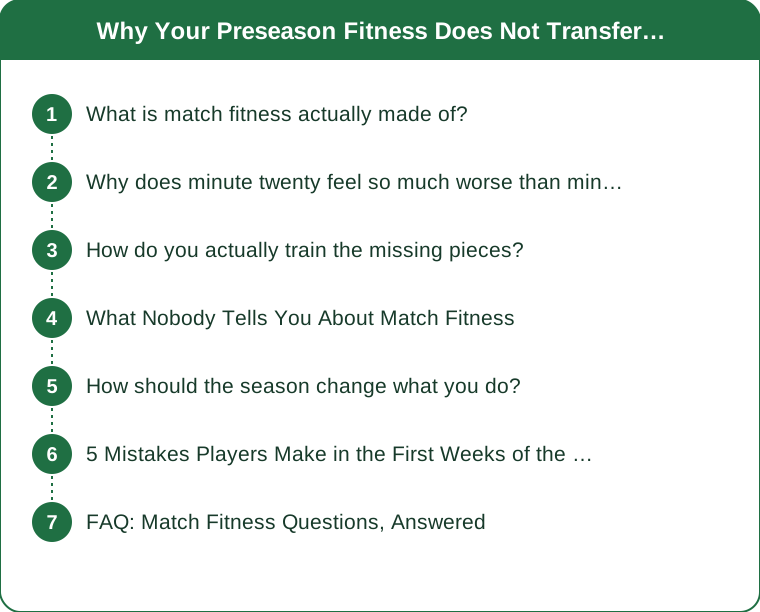
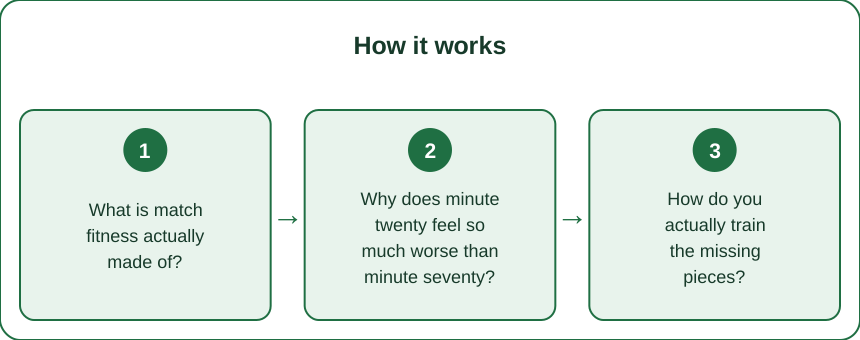
What is match fitness actually made of?
Four distinct qualities, and only one of them is what most preseason running develops.
Aerobic base. The engine that clears metabolites between efforts and lets you keep going for ninety minutes. Steady running builds this well, and it is genuinely necessary. It is also the part most players already have.
Repeated sprint ability. The capacity to produce a near maximal effort, recover partially in twenty to forty seconds, and produce another one nearly as good. Match analysis consistently shows that high intensity actions come in clusters, with short recoveries between them, and this quality is what determines whether the fifth sprint in a passage of play is as fast as the first. Steady running does almost nothing for it.
Deceleration and change of direction capacity. Football is full of stopping, turning, and re accelerating. Decelerating is eccentrically demanding and it is what makes players sore after a match in a way that running never does. It also fatigues quickly, and when it goes, players start arriving late to challenges rather than losing top speed.
Cognitive load. Scanning, deciding, communicating, tracking runners. This is genuinely tiring, and it is absent from solo running. Decision quality degrades with fatigue before physical output does, which is why the first sign of match unfitness is usually a bad pass rather than a slow run.
A player with a strong base and none of the other three will feel fine jogging and be finished after twenty minutes of real play. That is the common case.
Why does minute twenty feel so much worse than minute seventy?
Because the first period of a match is played at an intensity nobody sustains, and an underprepared player pays for it immediately.
The opening of a game is the highest intensity phase for most teams. Pressing is organised, adrenaline is high, and the tempo is set before anyone has settled. A player whose repeated sprint ability is undertrained goes into significant fatigue during exactly this period.
What then happens is a partial recovery. The tempo drops, the game finds a rhythm, and the player who was drowning at twenty feels functional again by thirty five. This is the source of the confusing experience of feeling worse early and better later, and it is not imagination.
There is a second contributor: the warm up. A short, low intensity warm up leaves you completing the actual warm up during the first fifteen minutes of the match, which is both a fitness cost and an injury risk. Preseason sessions often begin gently by design, so players arrive at competitive fixtures with warm up habits that suit training rather than matches.
And a third, which is easy to overlook. The pace of a match is set by the opposition, not by you. In training you self select intensity constantly and mostly without noticing. In a match somebody else decides when you sprint, and it is repeatedly at the moment you would have chosen to rest.
That loss of control over pacing is a large part of what makes match play so much harder than any solo session of similar total distance.
How do you actually train the missing pieces?
By changing the shape of the work rather than the amount of it. Three formats do most of it.
Repeated sprint sets. The core of the missing quality. Six to ten efforts of four to six seconds, with about twenty to thirty seconds of recovery between them, done as two or three sets with a couple of minutes between sets. Short, brutal, and finished in fifteen minutes. The recovery is deliberately incomplete, because incomplete recovery is the thing being trained.
Small sided games. The most efficient tool available, because they train everything at once. Four against four on a small pitch produces high intensity actions, decelerations, turns, and constant decision making, in a format nobody has to be persuaded to do. Four minute blocks with two minutes rest, repeated four to six times, is a well used structure.
Change of direction and deceleration work. Shuttle runs with hard stops, and specifically the braking half of them. Eccentric strength is what protects you when the deceleration demands arrive, and it is trainable in the gym as well as on the pitch. Nordic curls and split squats have good support behind them for hamstring resilience.
What to keep from your existing running: one steady aerobic session a week maintains the base, and it is a useful recovery format. The mistake is making it the main content.
A sensible weekly shape in season for an amateur player: one repeated sprint or small sided session, one strength session including eccentric work, one lighter technical or aerobic session, and the match. That is enough, and it is the pattern that closes the gap fastest.
Two details that decide whether it works. Put the hardest session as far from the match as the week allows, because quality collapses on tired legs and a poor repeated sprint session trains you to sprint slowly. And keep the sessions short. Fifteen minutes of genuine high intensity work is a full dose; stretching it to forty minutes turns it into a moderate session that trains neither quality well.
One more piece that gets skipped. Practise the specific actions that break down first in matches — the recovery run back into position, the second and third sprint in a passage, the turn to face after receiving under pressure. These are trainable in isolation, and they are where fatigue shows up first on a Saturday.

What Nobody Tells You About Match Fitness
Positions have completely different demands. Full backs and wide midfielders cover the most high intensity distance; centre backs perform fewer but more maximal efforts; central midfielders cover the most total ground at moderate intensity. Training everyone identically underprepares somebody, and it is usually the wide players.
Fatigue shows in decisions before it shows in legs. The first symptom is a rushed pass or a missed scan, not a slow sprint. Coaches often read this as concentration and it is frequently conditioning.
The last fifteen minutes of a match is when most injuries occur. Fatigued muscles absorb less force and technique degrades, and the eccentric loads of decelerating are exactly where hamstrings and knees are vulnerable. Fitness is injury prevention, not just performance.
Preseason fitness fades fast if it is not maintained in season. Two or three weeks of matches only, with no conditioning, and repeated sprint ability declines measurably. In season maintenance is a genuine requirement rather than optional.
Warm ups matter more in cold weather, and by a wide margin. Fifteen to twenty minutes, progressive, finishing with a few near maximal efforts, so the first sprint of the match is not the first sprint of the day.
Being a good runner and being match fit are different things, and one does not imply the other. Some of the fittest looking players on a training run are the ones struggling at minute twenty.
Small sided games are underrated as conditioning because they do not feel like conditioning. Players will produce far more high intensity efforts in a competitive four against four than they will in a running session they have been told to complete, and the intensity is self generated rather than imposed.
Substitutes cool down faster than they expect. A player sitting for thirty minutes in autumn weather and then entering a match at full pace is entering cold, and that is a well known injury window.
How should the season change what you do?
Substantially, and the transition is happening right now for most players.
The move from preseason volume to in season maintenance is where most people get it wrong. Preseason is built on volume; in season is built on quality and recovery, because the match itself is now the hardest session of the week. Continuing preseason volume through a fixture list produces accumulated fatigue and injuries rather than fitness.
What changes as autumn arrives:
Warm ups need to be longer and more thorough. Cold muscles are stiffer and more injury prone, and the drop in temperature over the next several weeks is significant. Add five minutes and finish with progressive sprints, particularly for early morning and evening fixtures.
Pitches get heavier. Wet, soft ground raises the energy cost of every action, and it changes the demands of the game — more strength, slower play, more accumulated fatigue. A match in October is genuinely harder work than the same match in August.
Kit affects performance more than players expect. Being cold on the touchline and then entering play is a real injury risk, and staying warm between efforts matters. Layers that can come off, and something warm for substitutes, are practical rather than fussy.
Daylight shrinks, so training moves indoors or under lights, often on to different surfaces. Artificial surfaces change loading patterns and are a common source of new niggles in autumn.
Recovery becomes the limiting factor once fixtures come weekly. Sleep, food, and one genuinely easy day after each match do more for match fitness at this point in the season than an extra hard session does.
This is general training information rather than individual advice. If you have a current injury, a history of a significant one, or any medical condition affecting exercise, get guidance from a physio or doctor who can assess you rather than following a general plan.
5 Mistakes Players Make in the First Weeks of the Season
1. Keeping preseason volume once matches start. The match is now the biggest load of the week. Adding the old training week on top produces fatigue, not fitness, and it is the most common cause of early season injuries.
2. Warming up like it is a training session. A short jog and some stretching leaves you completing your warm up during the opening period, which is both slow and risky. Fifteen to twenty minutes, finishing with near maximal efforts.
3. Training only steady running. It builds a base and it does nothing for the repeated sprint quality that the game actually demands. If your conditioning does not include short maximal efforts with short recoveries, the gap will not close.
4. Skipping strength work once the season starts. Eccentric strength is what protects hamstrings during deceleration, and it declines quickly without maintenance. One short session a week holds it.
5. Ignoring the recovery day. Playing a match, then training hard within forty eight hours, is where accumulated fatigue starts. Amateur players often have less recovery than professionals and train as though they have more.
FAQ: Match Fitness Questions, Answered
How long does it take to get match fit?
Usually three to six weeks of match specific work, and it comes faster if you have an aerobic base already. The repeated sprint quality responds quite quickly, which is why players often feel a noticeable change after two or three weeks of the right training.
Is running more the answer if I am tired in games?
Rarely. If you are tired in games but comfortable on runs, the missing quality is repeated high intensity efforts with short recoveries, and more steady mileage does not train it.
What is the single most useful session?
Small sided games, because they train the physical, technical, and decision making demands simultaneously and at match like intensity. Four against four in short blocks is hard to beat.
Why am I so much more sore after a match than after training?
Decelerations and changes of direction, which are eccentrically demanding and largely absent from steady running. Building eccentric strength reduces both the soreness and the injury risk that comes with it.
TL;DR:
- Match fitness is repeated sprint ability, deceleration capacity, and cognitive load, not just aerobic base — and steady running trains only the base.
- Minute twenty is the hardest because opening intensity is highest and short warm ups leave you finishing the warm up in the match.
- Train the gap with short repeated sprints, small sided games, and eccentric strength work rather than more mileage.
- Cut volume once fixtures start, lengthen warm ups as the weather cools, and treat recovery as part of the training.
Swap one steady run this week for eight short sprints with twenty five seconds rest. You will recognise the feeling immediately.
Keep Reading
This article is for general informational and styling purposes only. Fit, sizing, and product availability may vary.