The Complete Guide to Playing With People Much Younger Than You
Quick Answer: Playing alongside much younger teammates is mostly a positioning and recovery problem, not a fitness one. Repeated sprints and day-after recovery decline earlier than skill, decision-making or endurance do — so the winning adjustments are to reduce the distance you have to cover through better positioning, to warm up considerably longer than they do, and to manage the week around the match rather than the ninety minutes within it. Your reading of the game is your advantage, and it is a genuinely large one.
The instinct is to try to keep up.
The better move is to change what keeping up means.

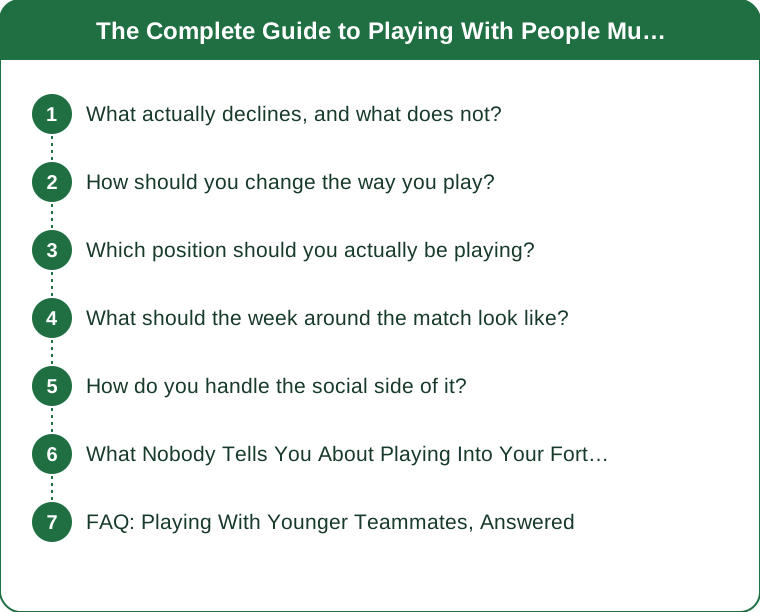
What actually declines, and what does not?
Getting this right determines every other decision, because the popular assumption — that you simply get worse at everything — is not what the picture looks like.
Declines earliest and most sharply:
Repeated sprint ability. Not top speed on a single effort so much as the ability to produce sprint after sprint with short recovery between them. This is the one that shows up as being fine for twenty minutes and cooked by thirty-five.
Recovery between sessions. The clearest and most consistent change people report. What used to take a day now takes two or three, and this is the factor that actually limits how much you can play.
Reactive power. Change of direction, jumping, the explosive first step. Trainable, but it declines faster than endurance does.
Tissue tolerance. Tendons and connective tissue take longer to adapt and are less forgiving of sudden increases in load. This is why calf and Achilles problems become the signature adult-league injury.
Declines slowly or not at all:
Aerobic endurance. Highly trainable at any age and one of the more resilient qualities. An older player who trains can genuinely out-last a younger one who does not.
Technical skill. First touch, passing weight, striking technique — all essentially preserved and still improvable.
Reading the game. This frequently continues to improve for decades. It is the single largest advantage available to you and it is worth building your whole approach around.
Composure. Decision-making under pressure improves with exposure, and you have far more exposure than they do.
So the honest summary is that you are slower and you recover worse, and you are probably better at football. Those are compatible, and the way to express both is positional rather than physical.
How should you change the way you play?
By making the pitch smaller for yourself. Every point below is a way of covering less ground for the same contribution.
Start from a better position rather than reacting from a worse one. The single biggest efficiency gain available. Two steps taken before the ball moves are worth ten taken after it. This requires you to watch the game rather than the ball, which is exactly the skill you have and they mostly do not.
Force play in one direction rather than trying to cover both. Showing an attacker onto their weaker side and staying goal-side beats attempting to win every ball. You give up the interception and you never get beaten for pace, which is a trade heavily in your favour.
Use the first touch to buy time rather than to beat someone. Taking the ball into space and playing early keeps you out of the physical duels that are hardest to win.
Talk constantly. Organising the players around you is genuinely valuable and it costs nothing physically. It also makes you the player everyone wants on their team regardless of how fast you are.
Pick your moments to press. Pressing every ball is how you empty the tank by half time. One good, well-timed, committed press per few minutes is worth more than continuous half-hearted chasing, and it is the specific habit that separates players who last from players who fade.
Play the pass a beat earlier. Releasing the ball before pressure arrives removes the need to escape pressure, which is where the sprints and the injuries come from.
None of this is a compromise version of football. It is how experienced players play, at every level.
Which position should you actually be playing?
The one that concentrates your contribution and limits your repeated sprints. A few honest assessments:
Centre-back is frequently the best home for an older outfield player. Reading, organising and positional discipline matter more than pace, and you can defend by anticipating rather than chasing — provided you are not left in isolated foot races, which is a team-shape issue as much as a personal one.
Central midfield, deeper role. High touch count, high influence, and you can dictate tempo. The distance covered is real but it is mostly at moderate intensity, which suits an aerobic base far better than repeated sprinting does.
Full-back is the hardest ask in most adult formats, because it demands repeated high-speed running up and down a touchline. It is the position most likely to expose the exact quality that declines first.
Winger, similarly demanding. Unless you play as an inside forward who receives in space rather than running in behind.
Goalkeeper is a genuine option and it is worth saying out loud. Plenty of people extend their playing years by a decade this way, and if you have decent hands it is far more enjoyable than the reputation suggests.
Small-sided formats change everything. Five, six and seven-a-side compress the pitch, which reduces long sprints and increases the value of touch and positioning. Many players find they are more effective in small-sided football at forty-five than they were at twenty-five, and this is a genuinely good reason to move formats rather than a consolation.
The conversation to have with a captain is about the role, not about your age. “I’m most useful in the middle” is a football conversation.

What should the week around the match look like?
This is where most of the real difference is made, and it is almost entirely unglamorous.
Warm up considerably longer than the twenty-somethings do. They can arrive five minutes before kick-off and be fine. You cannot, and this is not a moral failing — tissue takes longer to become compliant and the first ten minutes are where most muscle injuries happen. Fifteen to twenty minutes, building genuinely to sprint speed before the whistle. Arriving early is the single most protective thing on this list.
Include some sprinting during the week. The instinct is to avoid it because it is uncomfortable and it feels risky. But sprint capacity has to be maintained or the first flat-out sprint of the match becomes the injury. Two short sessions of a handful of build-up sprints per week does most of the work.
Strength train. Two sessions a week covering the posterior chain, calves and single-leg work. This is the best-supported protection available against the injuries that end adult seasons, and it also slows the decline in power more effectively than playing more football does.
Treat the day after as part of the plan. Light movement, a walk, some easy cycling. Complete rest generally feels worse than gentle activity.
Sleep is the recovery variable that actually matters. More than any supplement, garment or protocol. If you play midweek evenings and get six hours afterwards, that is your limiter.
Cap the number of hard sessions. One competitive match plus one or two training sessions is plenty for most people over forty. Adding a second match is where problems start.
As the season moves into colder, wetter months, add ten minutes to the warm-up and expect heavy pitches to raise the physical cost of the same ninety minutes considerably.
How do you handle the social side of it?
Worth addressing directly, because it is what makes people quit more often than the football does.
Do not make your age the running joke. If you introduce it, it becomes the frame everyone uses. Most younger teammates genuinely do not care, and they take their cue from you.
Do not coach unless asked. The fastest way to become unpopular is to give unsolicited tactical instruction to people twenty years younger. Organising during play is football. Post-match analysis of someone’s positioning is not, unless they ask.
Do offer what you know when it is wanted. Younger players frequently want to know things and will not ask directly. Answering a question well once tends to open the door properly.
Be honest about what you can play. “I can do sixty minutes properly or ninety at seventy per cent” is useful information for a captain and it is respected. Pretending otherwise and fading badly is worse for the team than the substitution would have been.
Accept the substitution well. How you come off matters more socially than how you play. Someone who takes a sixty-fifth minute change gracefully gets picked more often than someone who sulks.
Find the other older players. Most adult teams have two or three, and they are a useful source of realism about what to expect.
And on the flip side — the physical gap is usually far more visible to you than to anyone else. Most teams value a reliable, available, technically sound player who turns up every week enormously, and availability is a quality that improves with age rather than declining.
What Nobody Tells You About Playing Into Your Forties
The first fifteen minutes lie. You will feel excellent. Adrenaline and a fresh tank mask everything, and the temptation is to spend the match at that rate. The players who last pace the first fifteen deliberately, which feels wrong and pays off after half time.
Your fitness comes back faster than your resilience. Two weeks of training will restore a lot of your capacity, and your tendons will not have caught up. This mismatch — feeling ready before being ready — is behind most early-season injuries in returning adult players.
Calf injuries arrive without warning. The signature adult footballer injury, and it typically has no build-up. Calf raises twice a week are dull and they are the best insurance available.
Small-sided football is not a downgrade. More touches, more involvement, less running, and frequently more enjoyable. A lot of people play worse football on a full pitch out of a sense that it is the real version.
You will be better in month three than month one. Match sharpness is a real thing and it takes longer to arrive at forty than at twenty. Judging yourself on your first two games back is judging the wrong sample.
The thing that ends most adult careers is not decline. It is an avoidable injury caused by an inadequate warm-up in week one of a season, followed by three months out, followed by never quite going back. Almost everything on this page is worth less than simply arriving twenty minutes early and warming up properly, every single time.
FAQ: Playing With Younger Teammates, Answered
Should I tell the captain about my limits?
Yes, and frame it in football terms. “I’m best in the middle and I’m most useful in the first sixty” is far better received than anything mentioning age, and it gives them something they can actually plan around.
Am I more likely to get injured?
On balance, yes — tissue tolerance and recovery both decline, and both are modifiable. Consistent strength work, a long warm-up and sensible weekly load close a substantial part of the gap.
How much should I be training outside matches?
Two strength sessions and one or two football or running sessions is a good general shape. The strength work is not optional if you want to keep playing for years; it is the highest-value part of the week.
Is it worth switching to small-sided football?
For a lot of people, yes. More involvement, less repeated sprinting, easier to organise, and gentler on the calendar. It is a genuinely good version of the game rather than a retirement home for it.
What if I genuinely cannot keep up?
Change position before you change your mind about playing. A move from full-back to centre-back or from winger to central midfield frequently solves the entire problem, and it is a conversation worth having before you conclude anything.
How long does it take to get match fit?
Expect six to eight weeks of regular playing and training rather than two or three. Match sharpness lags general fitness, and this gap widens with age. Building a base before the season rather than during it is the difference.
If you have any existing cardiac or joint condition, or you have been inactive for a long period, get medical clearance before returning to competitive football. This is general information, not medical advice.
TL;DR:
- Repeated sprint ability and recovery decline first; endurance, technique and game reading barely do
- Play positionally to make the pitch smaller for yourself — two steps before the ball beats ten after it
- Centre-back, deeper midfield and small-sided formats suit the qualities you keep; full-back and winger expose the ones you lose
- Warm up fifteen to twenty minutes, do two strength sessions a week, and treat the day after as part of the plan
- The thing that ends adult careers is an avoidable week-one injury, not gradual decline
Arrive twenty minutes early to your next match and warm up properly to full sprint speed before kick-off. It is the least interesting suggestion on this page and it protects more seasons than everything else combined.
Keep Reading
This article is for general informational and styling purposes only. Fit, sizing, and product availability may vary.