The Complete Guide to Preseason Conditioning That Transfers to Match Day
Quick Answer: Match fitness is intermittent - repeated high-intensity efforts with incomplete recovery, plus decelerations, changes of direction and constant low-level movement. Continuous running builds an aerobic base that supports that, but it does not train it. A preseason that transfers has four elements in order: an aerobic base, repeated sprint ability, change-of-direction and deceleration work, and match-specific volume with the ball. Skipping the third element is why people arrive fit and still cramp at 70 minutes.
You ran all summer. Your resting heart rate is lower and your 5k is faster.
And at the hour mark of the first friendly your legs were gone anyway.

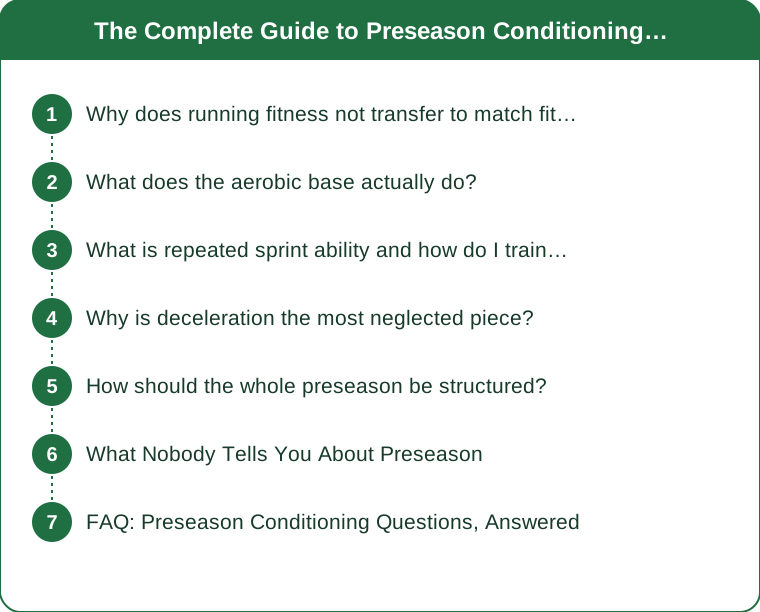
Why does running fitness not transfer to match fitness?
Because a match is not a run. Match play consists of repeated short high-intensity efforts separated by incomplete recovery, with a great deal of low-intensity movement in between.
Continuous running trains a steady-state system, which supports recovery between efforts but does not train the efforts themselves.
The cost of decelerating and changing direction is substantial and is almost entirely absent from straight-line running. Eccentric loading during deceleration is a major contributor to match fatigue and soreness.
Match play also involves constant unpredictable stopping and starting, which loads tissue differently from a rhythmic gait.
And the cognitive load is real. Making decisions while fatigued is its own skill, and it degrades faster than physical capacity in people who trained without a ball.
Which is why players return from a summer of running and still struggle - they built the base and skipped the specific work.
None of this means running is useless. The aerobic base underpins repeated sprint ability and recovery between efforts. It is the foundation, not the building. This is general information, not medical advice.
What does the aerobic base actually do?
It determines how quickly you recover between high-intensity efforts, which is the single most important physical quality in intermittent sport.
A better aerobic base means the fifteenth sprint is closer to the first, which is what people mean when they say someone lasts.
It supports the low-intensity movement that fills most of a match - the jogging, repositioning and walking that accounts for the majority of distance covered.
Build it early in preseason, when specific work is less appropriate and volume is well tolerated.
Continuous running, cycling and rowing all contribute, and mixing modes reduces the repetitive loading that produces overuse problems in a heavy block.
Two to three aerobic sessions a week in the early phase is a common structure, tapering as specific work increases.
And the base does not need to be maintained at the same volume once built - it holds reasonably well with reduced volume while you shift emphasis to sharper work.
Vary the format so it does not become a running programme. Continuous steady running, longer intervals of three to five minutes at a hard but sustainable effort, and tempo work all build the same underlying quality through different routes, and rotating them reduces the repetitive loading that causes shin and calf problems in a heavy block.
Longer intervals are particularly efficient here, because they accumulate time at a high percentage of maximum without the joint cost of very long continuous runs.
Judge the base by recovery rather than by pace. If your heart rate is still elevated ninety seconds after a hard effort, the base is the limiting factor rather than your sprint speed.
What is repeated sprint ability and how do I train it?
Repeated sprint ability is the capacity to produce high-intensity efforts repeatedly with limited recovery, and it is the quality that most closely resembles match demand.
Train it with short maximal efforts and incomplete rest. A common format is 6 to 10 sprints of 20 to 40 metres with 20 to 30 seconds recovery, for two to four sets.
The recovery is the training variable. Full recovery makes it speed work; incomplete recovery makes it repeated sprint work. Both are useful and they are not the same session.
Quality matters - stop the set when times drop off substantially, because sprinting slowly while exhausted trains something other than sprinting.
Two sessions a week is plenty alongside everything else, and this work is demanding enough that more is usually counterproductive.
Include some efforts from a rolling start and some from standing, since matches involve both.
And build gradually. Sprint work has a real injury risk profile, particularly for the hamstrings, and volume should increase progressively rather than being introduced at full volume in week one. This is general information, not medical advice.

Why is deceleration the most neglected piece?
Because it is invisible in a training log and unpleasant to do. Nobody records decelerations, and nobody enjoys them.
Deceleration is eccentric loading, where muscle lengthens under tension, and it produces far more muscle damage and soreness than the equivalent acceleration.
A match contains hundreds of decelerations and changes of direction, and tissue unprepared for that load is the reason preseason-fit players are wrecked after the first competitive game.
Train it deliberately: sprint-to-stop drills, decelerate-and-cut patterns, and controlled change-of-direction work at increasing speed.
Start submaximal and progress. Full-speed cutting in week one of preseason is a common way to start a season injured.
Include lateral and backward movement, which is a substantial proportion of match movement and almost never appears in running-based preparation.
And note that eccentric strength work in the gym supports this directly - Nordic hamstring curls and similar exercises have strong evidence behind them for hamstring injury reduction in football populations. This is general information, not medical advice.
How should the whole preseason be structured?
Phase one, weeks one to two: aerobic base and general strength. Higher volume, lower intensity, get the tissue used to load again. Introduce eccentric strength work early and progressively.
Phase two, weeks three to four: introduce repeated sprint work and change-of-direction drills while maintaining aerobic volume. Intensity rises, volume holds.
Phase three, weeks five to six: match-specific volume with the ball, small-sided games, and full-speed movement. Aerobic volume reduces as specific volume rises.
Phase four, the final week: sharpen and reduce. Volume comes down, intensity stays, and the aim is arriving fresh rather than arriving tired.
Throughout: two strength sessions a week, with eccentric hamstring work, single-leg work and posterior chain loading as the priorities.
Monitor how you feel session to session rather than only following the plan, since preseason is where load errors produce the injuries that define a season.
And do not compress six weeks into three. The most common cause of preseason injury is a rapid increase in load in players who did little over the off-season, and the research on training load spikes is consistent enough to take seriously.
If you only have four weeks, cut the aerobic phase rather than the specific work, and accept a lower ceiling rather than trying to fit six weeks of loading into four. Compressing the plan is how the season starts with three players unavailable.
Keep one genuinely easy day between the two hardest sessions each week. Preseason plans routinely stack a heavy pitch session, a gym session and a match into consecutive days, and the accumulated load is what produces the week-three wall.
Build the ball work in from phase two rather than phase three. Touch and decision-making degrade during a summer off, and running-only preparation means arriving physically ready and technically rusty - which shows up in matches as poor first touches under fatigue rather than as a fitness problem.
And write the plan down before it starts. Preseason done by feel drifts toward whatever is enjoyable that day, which is usually more running and less of the eccentric and deceleration work that actually keeps you available in October.
What Nobody Tells You About Preseason
The gym work is where most of the injury prevention lives, and it is the first thing dropped. Eccentric hamstring work has some of the strongest evidence in sports medicine for reducing hamstring injury rates in footballers, and it takes about ten minutes twice a week. It is skipped constantly because it is boring and produces soreness.
Fitness testing at the start of preseason predicts very little on its own, but the change across preseason predicts a lot. A single beep test result is far less useful than the same test repeated at weeks one, four and six.
Sleep is a training variable in preseason specifically, because the load is high and adaptation happens during recovery. Players who compress preseason into a busy summer of late nights consistently adapt worse and pick up more niggles.
The second week is when most problems appear, not the first. Delayed onset soreness, accumulated fatigue and the point at which enthusiasm outruns tissue readiness all land at the same time.
Match fitness needs matches. No amount of conditioning replicates the specific demand of competitive play, which is why the first two or three matches always feel disproportionately hard regardless of how well preseason went.
Small-sided games are extremely effective conditioning and are consistently underrated as fitness work because they are enjoyable. They produce high heart rates, repeated efforts, changes of direction and decision-making under fatigue simultaneously.
Playing yourself fit works better than running yourself fit for the last phase, but only if the base is already there. Skipping straight to small-sided games with no aerobic foundation produces a player who is sharp for twenty minutes.
And the hardest part is the taper. Reducing volume in the final week feels like losing fitness, and it is the difference between arriving ready and arriving flat. This is general information, not medical advice.
FAQ: Preseason Conditioning Questions, Answered
How long should preseason be?
Six weeks is a common structure for amateur players returning from an off-season. Less than four weeks means either accepting lower readiness or increasing load faster than is comfortable, which is where injuries cluster.
Is long slow running a waste of time for football?
No - it builds the aerobic base that determines recovery between high-intensity efforts. The mistake is doing only that, not doing it at all.
How many sprint sessions per week?
Two is generally plenty alongside pitch work and strength training. Sprint work is demanding and carries real injury risk, so quality and progression matter more than frequency.
Should I do gym work during preseason?
Yes - two sessions a week with eccentric hamstring work, single-leg strength and posterior chain loading. It is the part with the strongest evidence for injury reduction and the part most often dropped.
Why am I still tired at 70 minutes despite good fitness?
Usually because your conditioning was continuous rather than intermittent, and because deceleration and change-of-direction loading was not trained. Both produce fatigue that straight-line fitness does not prepare you for.
How do I avoid injury in the first two weeks?
Progress load gradually, do not jump straight to full-speed cutting, include eccentric strength work from the start, and prioritise sleep. Rapid load spikes in players returning from inactivity is the main risk pattern.
Do small-sided games count as conditioning?
Very much so. They produce high heart rates, repeated efforts, changes of direction and decision-making under fatigue at once, which is closer to match demand than any running session. This is general information, not medical advice.
TL;DR:
- Match fitness is intermittent; continuous running builds the base but does not train the demand.
- Build in order: aerobic base, repeated sprint ability, deceleration and change of direction, match-specific volume.
- Deceleration is the most neglected element and the reason fit players are wrecked after the first match.
- Two strength sessions a week with eccentric hamstring work is the highest-evidence injury reduction available.
- Progress load gradually - rapid spikes after an inactive off-season is the main injury pattern.
- Small-sided games are excellent conditioning and are underrated because they are enjoyable.
- Taper the final week, even though reducing volume feels like losing fitness.
Run to build the base, then train the actual demand. This is general information, not medical advice.
Keep Reading
This article is for general informational and styling purposes only. Fit, sizing, and product availability may vary.