Why Your First Touch Still Bounces Away Even After Weeks of Drills
Quick Answer: Drilled first touch (controlled, predictable passes in isolation) and game first touch (unpredictable speed, angle, and pressure) train different skills — improving in drills doesn’t automatically transfer to games because games add decision-making under pressure that static drills never simulate. Closing that gap requires deliberately adding unpredictability and pressure to practice, not just more repetition.
You can control a rolled pass from a stationary partner ten times in a row without issue. Then a game ball arrives at a slightly different speed, from a slightly different angle, with a defender closing in, and it pops right off your foot. That’s not a sign you haven’t practiced enough — it’s a sign of exactly what you’ve been practicing.
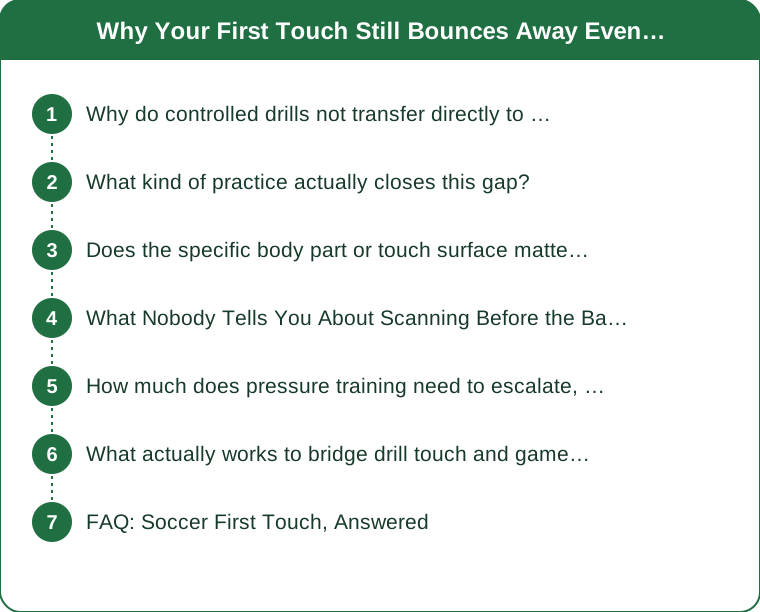
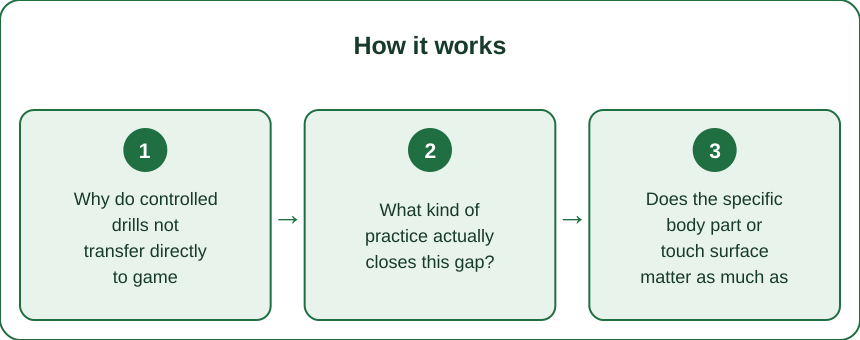
Why do controlled drills not transfer directly to game situations?
Static and predictable drills — a partner rolling you the same pass at the same speed and angle repeatedly — train your foot to make small, precise adjustments for a known input. A game ball rarely arrives the same way twice: speed, spin, height, and angle all vary, and a defender’s presence adds a decision-making load (where’s my next touch going, who’s pressuring me) that a cone drill never asks you to handle simultaneously.
This is why players who look technically excellent in isolated training sometimes still struggle with touch under real match conditions — the skill being trained and the skill being tested aren’t quite the same thing.
What kind of practice actually closes this gap?
Reactive, varied-input training — a partner or coach feeding passes at random speeds, angles, and heights rather than a repeated pattern — forces your first touch to adapt in the moment rather than execute a memorized adjustment. Adding a passive defender who closes distance as you receive (even without actively tackling) introduces the decision-pressure element that static drills strip out entirely.
Does the specific body part or touch surface matter as much as speed of decision?
Both matter, but decision speed is often the more limiting factor for intermediate players. A technically sound touch with the wrong body part chosen half a second too late still results in a bad touch under pressure, while a slightly less perfect touch made with a fast, correct decision often plays out better in an actual game sequence.
What Nobody Tells You About Scanning Before the Ball Arrives
Here’s the piece most players never get explicitly coached on: elite first touch quality is heavily determined by information gathered before the ball even arrives — checking over your shoulder for pressure and space in the 1-2 seconds before receiving. Players with technically similar foot skills often have dramatically different game touch quality purely because one is scanning the field constantly and the other is watching the ball approach with no pre-planned next move.
How much does pressure training need to escalate, and what’s actually going wrong in games?
It doesn’t need to be full-intensity defending to be effective — even a passive defender standing close and shadowing without tackling meaningfully changes how a receiving player processes the touch, compared to fully uncontested space. Gradually increasing that pressure over weeks, rather than jumping straight to full-speed match conditions, builds the adaptation without overwhelming technique that’s still developing.
7 Reasons Your Practiced First Touch Falls Apart in Games
- Drills use predictable, repeated passes — games never repeat the same input twice.
- No decision-making load in isolated practice — games add ‘where next’ on every touch.
- No defender presence during most drilling — even passive pressure changes processing completely.
- Limited scanning practice before the ball arrives — pre-touch information matters more than foot technique alone.
- Fixed passing speed and angle in training — games vary both unpredictably.
- Comfort with one dominant surface — games demand different touch surfaces depending on ball arrival angle.
- Practice happens in low-fatigue conditions — game touch quality drops under real physical fatigue that isolated drilling rarely replicates.
What actually works to bridge drill touch and game touch over a season?
A layered progression works best: start with varied-speed passing (no defender), add a passive defender for a few weeks, then add light active pressure, and finally incorporate small-sided games (3v3, 4v4) that naturally combine unpredictability, pressure, and decision-making all at once. Small-sided games specifically are heavily used by academy-level coaching precisely because they compress all the missing game-transfer elements into a single training format, rather than trying to isolate and drill each piece separately.
FAQ: Soccer First Touch, Answered
How long does it typically take to close the drill-to-game touch gap?
Many players notice meaningful improvement after 4-6 weeks of consistently adding varied-speed and pressured practice, though full game-speed comfort often takes a full season.
Should beginners skip static drills entirely and jump to pressured practice?
No — static drills still build the foundational technique; the key is progressing toward pressure and variability once basic control is solid, not skipping the foundation.
Does watching game film help first touch specifically?
Yes, particularly for the scanning habit — watching how experienced players check over their shoulder before receiving helps build the pre-touch awareness that pure physical drilling doesn’t directly teach.
TL;DR:
- Predictable drills and unpredictable game touches train genuinely different skills — repetition alone doesn’t close that gap
- Adding varied speed, angle, and even passive defensive pressure to practice closes it faster than more static reps
- Scanning the field before the ball arrives often matters more than raw foot technique
- Small-sided games (3v3, 4v4) compress all the missing elements into one training format
This week, ask a training partner to vary pass speed and angle randomly instead of feeding you the same pass — that single change targets the exact gap causing the bounce-away touches in real games.
Keep Reading
This article is for general informational and styling purposes only. Fit, sizing, and product availability may vary.