Why Your First Touch Falls Apart in a Real Match (Even Though It's Fine in Practice)
Quick Answer: Practice touch relies on repetition in a predictable setting, while match touch requires processing an approaching defender, teammate positions, and next-action decisions simultaneously — the touch itself doesn’t get worse under pressure, your attention just gets split three ways at once.
Your first touch looks clean in every training drill. Then a real defender closes the gap, and the ball bounces off your foot like you’ve never played before. That gap is real, and it’s not really about technique.

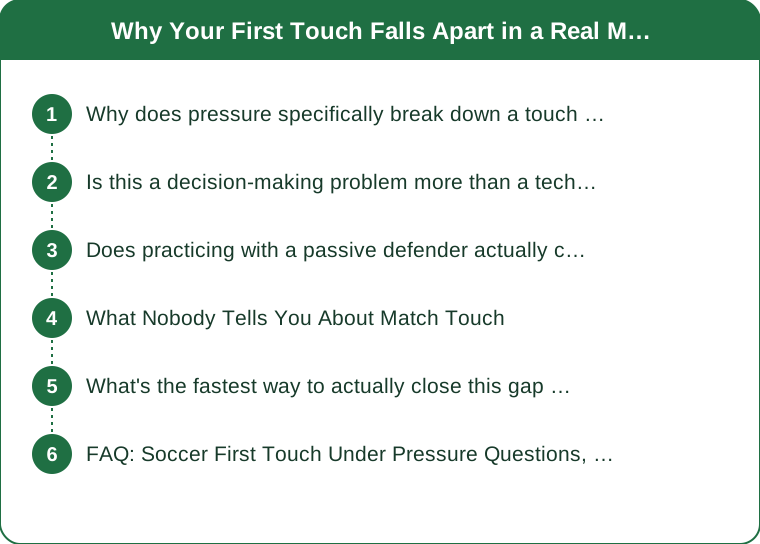
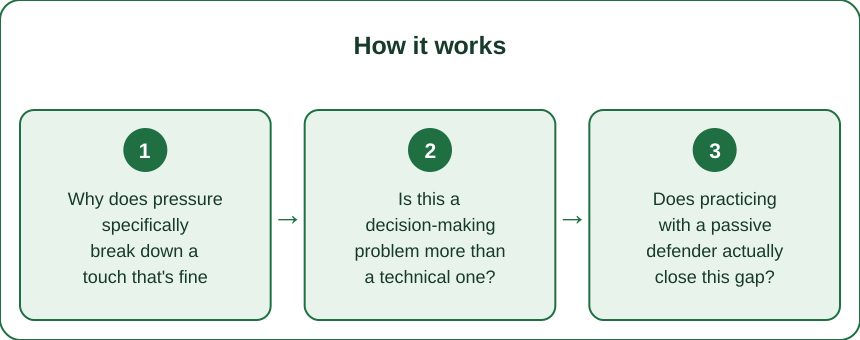
Why does pressure specifically break down a touch that’s fine in drills?
Cone drills and passing lines let you focus 100% of your attention on the ball itself. A match adds simultaneous defender tracking and decision-making about your next action, splitting attention across three things at once — and touch quality measurably drops when attention is divided, even if the physical skill hasn’t changed at all.
Is this a decision-making problem more than a technical one?
Largely, yes — most match-touch failures happen because a player is still deciding what to do next while the ball arrives, rather than committing to a touch direction beforehand. Players who scan the field and pre-decide their next action before the ball reaches them consistently show cleaner first touches under pressure than those reacting in the moment.
Does practicing with a passive defender actually close this gap?
Meaningfully, yes — adding even a single, low-intensity defender to touch drills forces the divided-attention pattern a real match requires, which cone-only training never replicates. Many coaches underuse this because it slows down repetition count, but the pressure-adapted touch it builds transfers far better to games.

What Nobody Tells You About Match Touch
Most first-touch coaching focuses entirely on foot mechanics and rarely addresses the scanning habit that determines whether you’re ready for the ball before it arrives. A technically perfect touch executed a half-second too late, because you were still scanning, fails just as often as a mechanically sloppy one.
It’s also rarely mentioned that touch quality under fatigue late in a match degrades faster than early-game touch, meaning some “pressure” failures are really conditioning failures showing up as technical ones.
What’s the fastest way to actually close this gap in training?
Small-sided games with a shot clock or limited touches force the same divided attention a real match creates, far more than isolated technical drills do. Pairing this with deliberate pre-scan habits — checking over your shoulder before the ball arrives, every single repetition — builds the exact skill that breaks down under match pressure.
FAQ: Soccer First Touch Under Pressure Questions, Answered
Does this affect advanced players as much as beginners?
Less so, but it never fully disappears — even professional players show measurably better touch with more time and space than under tight, split-second pressure.
Should I slow drills down to get technique right before adding pressure?
Some slow, technique-focused reps still help early on, but pressure should be introduced well before technique feels “perfect,” since perfect touch in isolation doesn’t predict match performance.
Does scanning before the ball arrives really make that much difference?
Yes — players who consistently scan report needing meaningfully less time to process what to do once the ball actually arrives, which is most of what separates a clean pressured touch from a rushed one.
TL;DR:
- Match touch fails because attention splits across the ball, a defender, and a decision, not because technique degrades
- Pre-scanning before the ball arrives is often more valuable than more isolated touch repetitions
- Adding even a passive defender to touch drills builds pressure-adapted skill cone drills can’t
- Late-match touch failures are sometimes fatigue, not a real technical or mental gap
A clean first touch in a cone drill was never really the test — training your attention to split three ways at once is what actually shows up on matchday.
Keep Reading
This article is for general informational and styling purposes only. Fit, sizing, and product availability may vary.