Why Playing Out of Position Makes You a Better Soccer Player
Quick Answer: Every position sees the game from a different geometry, and the fastest way to understand what your teammates need from you is to spend a night needing it yourself. A striker who plays a match at right back learns which runs are actually passable. A defender who plays a half in midfield learns why the outlet pass never comes. In rec league, where rosters are short and someone always has to fill in, the player who can cover three spots is the most valuable name on the text thread — and usually the one improving fastest.
The night out of position is not a wasted night. It is the film session you cannot get any other way.

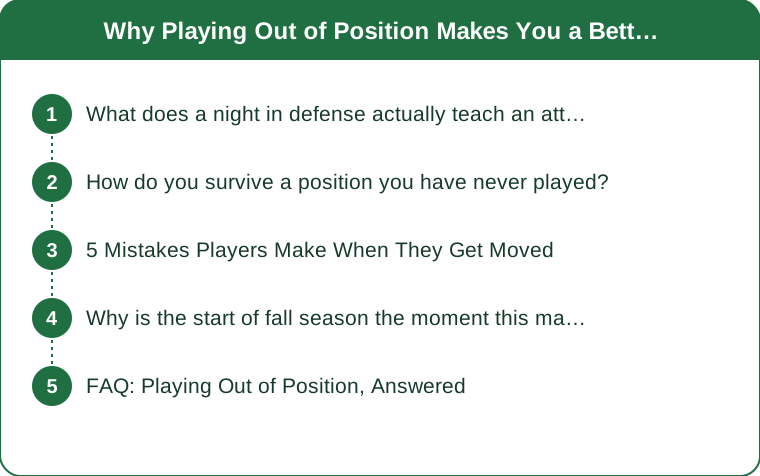
What does a night in defense actually teach an attacker?
What you look like from behind — which is the view every pass to you comes from.
Play up top and your sense of the game is built from one angle: facing goal, back to your own defense, wanting the ball. Spend ninety minutes at right back and you suddenly see what the passer sees: which runs open a lane and which just look busy, how a striker who checks toward the ball creates an option while one who only sprints away creates a fifty yard prayer, and how enormous the difference is between a target who shows for the ball early and one who appears at the last second.
That lesson travels straight back to your real position. The attackers who are easiest to pass to are almost always former somethings else — they time their runs to the passer’s rhythm instead of their own, because they have stood in the passer’s boots.
The reverse commute works identically. A defender who plays a night up top learns how lonely a striker is when the ball arrives with no support, and starts pushing up faster afterward. A winger who covers central midfield discovers what it costs when wide players never track back, and becomes the winger who does.
There is also a scanning upgrade nobody warns you about. Unfamiliar positions force you to check your shoulders constantly because nothing is automatic yet — and that scanning habit, once installed, is the single trait coaches say separates players who see the game from players who chase it. Comfort had been letting you skip it. Discomfort reinstalls it.
How do you survive a position you have never played?
Simplify ruthlessly, ask one question before kickoff, and talk more than feels natural.
Ask the captain one thing: what is my job when we lose the ball? Attacking roles improvise fine, but defensive responsibility is where out of position players get burned. Knowing whether you chase the ball, hold a zone, or track a runner covers eighty percent of the night.
Play two touch and play the simple ball. The out of position night is not the night for your highlight reel. Receive, pass to the nearest open shirt, move. Boring and effective is the entire assignment — and it is genuinely good training, because simple soccer under light pressure is what skilled players do most of the time anyway.
In defense, learn the two golden rules fast: stay goal side of your attacker, and never dive into a tackle when you are the last cover — delay, stay big, and wait for help. A slow defender who positions well beats a fast one who lunges, every week of the season.
Do not dribble in your own third. The risk to reward is catastrophic there, and it is the most common out of position sin.
Say what you see. New position players go quiet out of humility, which is backwards — you need more communication, not less. A simple time, man on, or send it, called early, covers for everything your feet do not know yet.
And afterward, notice what confused you. The moments you did not know where to stand are a map of what you never understood about the game — which is precisely the treasure.

5 Mistakes Players Make When They Get Moved
1. Sulking through the shift. Coasting at right back because you wanted to be up top is visible from the parking lot, and it teaches nothing. The players whose stock rises are the ones who treat the fill in shift as an audition.
2. Playing the old position from the new spot. The striker asked to play fullback who still floats forward hunting goals leaves a hole the whole team falls into. Run the new job description, not the old one from new coordinates.
3. Overcomplicating on the ball. Nerves push people toward proving themselves with ambition — the forty yard switch, the dribble past two. The professional move in an unfamiliar role is aggressive simplicity.
4. Going silent. The instinct is to hide until you figure it out. But your teammates would rather hear an honest who do I pick up on corners than discover the answer when it is in the net.
5. Refusing next time. One awkward night convinces some players to declare they can only play one spot, which is exactly backwards — the second night out of position is dramatically easier than the first, and by the third, you are the flexible player every rec team is desperate to keep.
Why is the start of fall season the moment this matters?
Because September rosters are chaos, and chaos hands out these lessons whether you volunteer or not.
Fall leagues are kicking off now, and the first three weeks are musical chairs — new players unassessed, vacationing regulars, captains juggling lineups. This is statistically when you will be asked to cover somewhere strange, and saying yes early buys you goodwill plus the lesson while the games still count less.
Preseason-fit legs make it survivable. Early season is also when everyone is freshest; an unfamiliar position costs extra running — you cover badly what you cannot read yet — and August legs handle that tax better than late October ones will.
A few practical notes for the early fall stretch:
The heat is not done. Evening kickoffs are still warm and humid through early September in most of the country, so hydration before the match and at halftime still matters, especially on a night when you are running more than usual in a strange role.
Dress for the swing. Late summer evening games start warm and finish cool. Shorts for the match with a layer for warmups and the sideline is the standard answer, and as the weeks cool, plenty of players move to lightweight leggings under shorts for evening games — just make sure anything under shin guards is thin enough not to shift them.
Volunteer before you are drafted. Telling the captain I can cover fullback or midfield if you are short changes your standing on the roster instantly. Every rec captain is one dropout text away from crisis, and the flexible player is the one who never gets benched.
By the time playoffs arrive in November, the player who spent September learning three positions is reading the game differently than the one who guarded their spot.
FAQ: Playing Out of Position, Answered
Which position teaches the most, fastest?
Central midfield — it faces both directions, touches everything, and forces constant scanning. It is also the most tiring, so it is a lesson best volunteered for when fresh. For pure eye opening value per minute, an attacker playing center back is hard to beat.
What if I am genuinely terrible at the new spot?
Expect to be — that is the price of the lesson, and rec league is the correct venue for it. Play simple, communicate, and remember that positioning errors are invisible to most spectators while effort is visible to everyone.
Should I tell the captain I have never played there?
Yes, in the same sentence as accepting. Never played back there, happy to do it, tell me my job — that sentence gets you coaching all night instead of blame at the end of it.
Does this apply to keepers?
Emergency keeper is its own genre and yes, everyone should do it once — nothing builds sympathy for the person behind you faster. But an untrained keeper should keep it to low stakes nights and prioritize catching over diving heroics. Gloves help more than pride does.
TL;DR:
- Every position sees a different game, and playing out of position shows you what your passes and runs look like from the other side.
- Survive it by asking your defensive job before kickoff, playing two touch simple, staying goal side, and talking constantly.
- Do not sulk, do not freelance your old role, and say yes again — the second time is far easier and makes you the roster’s most valuable player.
- September rosters guarantee someone gets moved; volunteering early buys goodwill, and warm evening games still call for hydration and a layered sideline plan.
Next time the captain scans the group text for a fill in, answer first. You will play one clumsy night and see the game clearly for the rest of the season.
Keep Reading
This article is for general informational and styling purposes only. Fit, sizing, and product availability may vary.