The Complete Guide to Switching From Full Pitch to Small-Sided Indoor Soccer
Quick Answer: Small-sided indoor soccer compresses time and space rather than simply shrinking the pitch. You get roughly a third of the time on the ball, pressure arrives from behind rather than in front, the surface removes the give your first touch was calibrated for, and there is no space to run into after you win possession. The adaptations that matter are a firmer, closer first touch, scanning before the ball arrives, using the sole of the foot to control and turn, and accepting that fitness demands are shorter and far sharper.
Good outdoor players routinely look poor in their first three indoor sessions, and it is almost never a skill problem.
This blog has covered playing on wet heavy fall pitches, reading the game instead of chasing the ball, and why touch quality drops under defensive pressure. Indoor is that last problem turned up to its maximum.
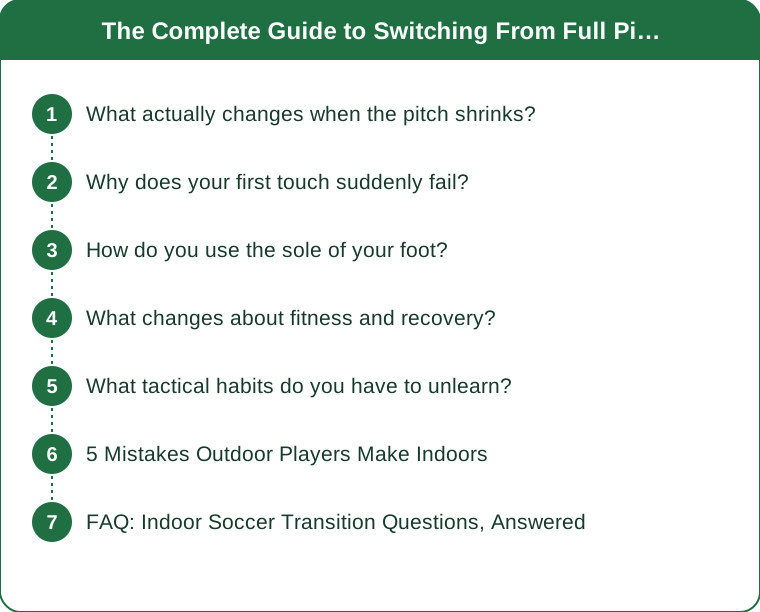
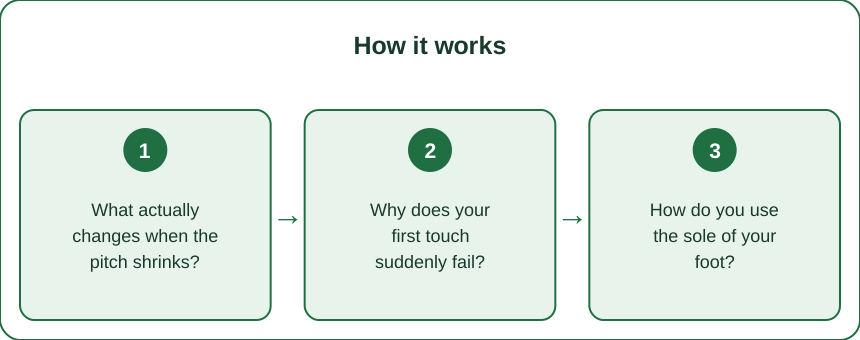
What actually changes when the pitch shrinks?
Far more than the dimensions, because space and time are the same variable in football.
Your average time on the ball drops sharply. On a full pitch a midfielder often has one to two seconds before a defender arrives. In a small-sided indoor game that frequently falls under a second, which is below the threshold at which you can control, look up, and then decide. The looking has to happen first.
Pressure arrives from more directions. Outdoors, with a touchline and offside line, threats come from a constrained set of angles. Indoors, with walls or boards and no offside, an opponent can be behind you when you receive, which is a fundamentally different information problem.
Ball speed off the surface increases considerably. A hall floor or artificial court has less friction and less give than grass, so a pass that would arrive comfortably outdoors arrives faster and higher off the ground.
The ball itself is often different. Futsal balls are smaller and low-bounce by design, and a low-bounce ball behaves very differently on the first touch and rewards sole control over the instep control most outdoor players default to.
There is nowhere to run after you win the ball. Outdoor recovery frequently produces a transition with space ahead; indoors you win possession and are immediately in traffic, which means the next action has to be a pass or a turn, not a carry.
Numbers matter disproportionately. Losing one player to a foul or a substitution is a far larger proportional change in a five-a-side game than in an eleven-a-side one, so possession discipline carries more weight than individual brilliance.
And the game never really stops. Boards keep the ball live, restarts are quick, and the total ball-in-play time in a small-sided game is often double that of an equivalent outdoor period.
Why does your first touch suddenly fail?
Because your first touch is a calibrated skill and every input to that calibration just changed.
Grass absorbs energy; hard courts do not. A touch that would die at a comfortable distance on turf runs an extra metre or more on a hall floor, which is exactly the gap a defender needs.
Outdoor touch is generally cushioning-oriented. You receive, let the ball settle, and then look. Indoors that sequence is too slow, and the correct touch is directional — receiving already moving into the space you intend to use.
The bounce profile is different. A low-bounce futsal ball comes off the surface flatter and faster, so an instep touch that expects a certain rise misjudges it consistently for the first few sessions.
You are receiving under pressure you did not see arriving. Almost all of what people diagnose as a technical failure indoors is actually a perception failure that happened a second before the touch.
Boards change the geometry of a bad touch. Outdoors a heavy touch goes out of play and you restart. Indoors it rebounds unpredictably and often straight to an opponent, which raises the cost of every error.
And you are probably taking too many touches. The outdoor habit of touch-touch-look is a luxury; indoors the effective pattern is closer to touch-and-release or touch-and-turn.
The fix is deliberately practised rather than absorbed. Ten minutes against a wall, receiving and releasing in two touches with a firm, angled first touch, transfers to the game faster than any amount of playing through it.
How do you use the sole of your foot?
It becomes your primary control surface indoors, and most outdoor players barely use it at all.
Sole control stops the ball dead on a hard surface where an instep touch lets it run. That is the single most valuable adjustment available.
It keeps the ball directly under your body, which protects it from a defender arriving from behind — the situation you are constantly in indoors.
The sole roll lets you move the ball laterally without a change of direction, which buys the half-second you no longer get from space.
Sole-based turns — the drag back and the L-turn — are faster in tight areas than the Cruyff and outside-foot turns that work well in open play.
It gives you a genuine stop-and-go weapon. Stopping the ball with the sole and accelerating changes the tempo far more effectively than trying to beat someone with pace in an area with no pace available.
And it enables the pass under your own body, which is a staple of small-sided play and simply not part of most outdoor players’ vocabulary.
Practise it cold and slowly. Rolling the ball side to side and forward and back for two minutes before every session is enough for it to start appearing in games within a few weeks. The barrier is unfamiliarity, not difficulty.
What changes about fitness and recovery?
The demand profile inverts: shorter, sharper, and much harder to recover from than the total distance suggests.
Distance covered drops but accelerations rise dramatically. Small-sided games produce far more changes of direction and short accelerations per minute than full-pitch play, and accelerations are the expensive part.
Deceleration load is the hidden cost. Stopping hard on a non-giving surface loads the quadriceps and the calf eccentrically, which is why indoor players report soreness in different places than outdoor players after the same nominal effort.
Hard courts do not absorb impact. Grass gives; a sports hall floor gives far less, so joint and tendon loading is higher per step even though there are fewer steps.
This is the classic autumn injury window. Moving from a soft outdoor surface to a hard indoor one without a build-up period is a well-recognised risk pattern, particularly for calf and Achilles complaints.
Play shorter shifts than you think you need. In small-sided formats, rolling substitutions exist for a reason, and playing through fatigue indoors degrades touch quality faster than it does outdoors because there is no recovery time within play.
Warm up for longer than the game seems to warrant. Ten minutes of graded movement, including changes of direction, matters more here than before a full-pitch game that starts at a walking tempo.
And build indoor volume across three or four weeks rather than going straight from one outdoor session a week to three indoor ones. Most of the injuries in this transition are volume-and-surface injuries rather than contact ones.
What tactical habits do you have to unlearn?
Mostly the ones built around space that no longer exists.
Stop making runs in behind. With no offside line and a defender able to drop deep, running in behind usually just removes you from the game. The valuable movement indoors is coming short to receive and creating angles.
Scan before the ball arrives, not after. The single highest-value habit indoors is a shoulder check in the second before you receive, because you will not have time afterwards.
Play the way you are facing more often. The outdoor instinct to turn and drive is frequently the wrong choice in traffic. A simple pass back to a supporting player who is facing forward moves the game far more effectively.
Support at angles, never in straight lines. A teammate directly behind or beside you gives one passing option; a teammate at 45 degrees gives several and is much harder to cover.
Defend by blocking passing lanes rather than chasing. Diving in indoors is heavily punished because a beaten defender cannot recover across distance the way they can outdoors.
Use the boards deliberately if your format has them. A pass off the wall is a genuine teammate that never gets marked, and outdoor players ignore it for months.
And accept a shorter shot selection. Long-range efforts that are a reasonable gamble outdoors are usually a turnover indoors, because there is no space for a rebound to fall into.
5 Mistakes Outdoor Players Make Indoors
All of them are outdoor virtues applied in the wrong context.
Mistake one: trying to dribble out of pressure. What works against one defender in space fails against two in a corner. Indoors, the ball moves faster than any player, so the pass out is almost always the better answer.
Mistake two: taking three touches. The outdoor rhythm of control, settle, decide is too slow. Get to two touches and, for anything in traffic, one.
Mistake three: wearing the wrong shoes. Outdoor boots on a hall floor are dangerous and often prohibited; running trainers offer no lateral support for repeated cuts. Flat-soled indoor court shoes are not optional equipment.
Mistake four: treating it as fitness training. The intensity is high enough that it needs to be treated as a hard session in your week, with recovery around it, rather than as a casual kickabout that happens to be indoors.
Mistake five: judging yourself on the first three sessions. The adaptation window for touch and scanning is roughly three to six sessions for most people. Players who quit indoors because they felt clumsy almost always quit inside that window.
The bonus mistake: ignoring the goalkeeper’s role. In small-sided formats the keeper is a genuine outfield option and a constant safe pass. Outdoor teams routinely leave that resource unused for an entire season.
FAQ: Indoor Soccer Transition Questions, Answered
Why am I so much worse at indoor soccer than outdoor?
Because you get roughly a third of the time on the ball, pressure can come from behind, and the hard surface makes your first touch run further than you expect. It is a perception and calibration problem, not a skill loss, and it typically resolves within three to six sessions.
Do I need special shoes for indoor soccer?
Yes. Flat-soled indoor court shoes give the lateral support and grip that repeated cutting demands, and most venues will not allow studded boots on their surface. Running trainers are the worst option because their raised, cushioned heel is unstable in lateral movement.
How long does it take to adapt to indoor soccer?
Most players report their touch and scanning feeling normal somewhere between the third and sixth session. The two things that speed it up are ten minutes of wall work receiving and releasing in two touches, and deliberately practising sole control and sole-based turns before each session. Playing more games without addressing either tends to produce a much slower adaptation, because the game itself never gives you enough repetitions of the specific skill in a calm enough situation to change the habit.
Why is indoor soccer so much more tiring than it looks?
You cover less distance but perform far more accelerations and hard decelerations, and the hard surface absorbs less impact than grass. Short shifts, a proper warm-up, and building volume over three or four weeks all matter more than they do outdoors.
This is general information, not medical advice. If you have persistent calf, Achilles or knee pain after moving to a hard surface, get it assessed.
TL;DR:
- Indoor small-sided soccer compresses time, not just space. Scanning before you receive is the highest-value habit to build.
- Hard surfaces make your first touch run further. Switch to a firmer, directional touch and use the sole of your foot to control and turn.
- Stop running in behind and stop dribbling out of pressure. Come short, support at angles, and play the way you are facing.
- The load is fewer steps but far more accelerations and hard stops. Build volume over three or four weeks and wear proper indoor court shoes.
Give it six sessions before you judge yourself. Almost everyone looks clumsy for the first three.
Keep Reading
This article is for general informational and styling purposes only. Fit, sizing, and product availability may vary.