The Complete Guide to Playing on Wet, Heavy Fall Pitches
Quick Answer: A wet, soft pitch changes three things at once — the ball decelerates faster and skids unpredictably, your footing loses lateral grip, and the surface absorbs energy that used to return it. The adjustments that matter most are hitting passes firmer, planting wider on turns, and shortening your first touch. Most fall technical decline is a surface problem being misread as a form problem.
Your passes keep dying five yards short. Your first touch bounces away. You slipped twice last week and you’re now half a step slow on every turn. The pitch changed in September, and your game hasn’t caught up.

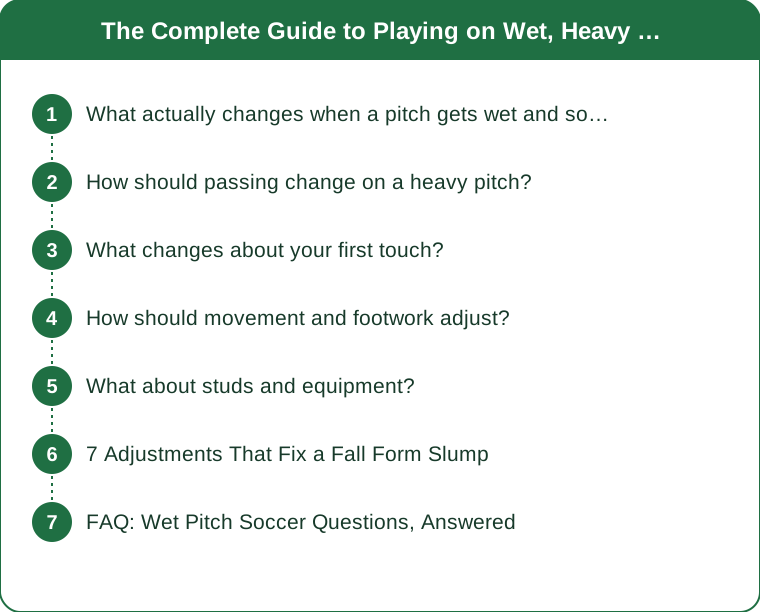
What actually changes when a pitch gets wet and soft?
Three separate physical changes, and they interact in ways that make the whole game feel different rather than just slower.
Rolling resistance goes up sharply. A dry, firm summer pitch returns most of the energy you put into a pass. A saturated one absorbs it — the grass lies flat and wet, standing water grabs at the ball, and soft ground under the surface deforms as the ball rolls over it. The same pass that traveled 25 yards in August travels 18 in October. This is the single biggest change, and it’s the one that quietly wrecks passing accuracy for the first few weeks of the season.
Skid behavior becomes unpredictable. On very wet grass with a firm base underneath, the ball can do the opposite — it skids and accelerates, especially on a driven pass or a ball played through a puddle. This produces the frustrating combination where some balls die and others run away, depending on where on the pitch they land. The pitch is no longer uniform.
Ground grip changes direction-dependently. Studs bite well enough going forward on soft ground, but lateral grip drops substantially. Wet grass on top of soft soil shears sideways under load, which is exactly what happens when you plant to change direction. Your forward acceleration feels close to normal; your cutting feels unsafe.
Energy return drops. Soft ground absorbs the force you push into it instead of returning it. Sprinting on a heavy pitch is measurably more expensive than on a firm one, which is why fall matches leave you more tired at the same perceived effort.
The reason it reads as a form slump
All four changes arrive at once, over a couple of weeks, and none of them announce themselves. The felt experience is “I’m passing badly and my touch is off” — which is a much easier conclusion to reach than “the rolling resistance coefficient changed.”
How should passing change on a heavy pitch?
Firmer, flatter, and with different target selection.
Add roughly 20 to 30 percent more weight to ground passes. This is the correction most players make too slowly, and they spend three weeks under-hitting before their body recalibrates. Making the adjustment deliberately in the warm-up — hitting ten passes at the distance you’ll actually use and watching where they finish — compresses that three weeks into ten minutes.
Strike through the middle of the ball, not under it. Any backspin or lift adds airtime that the wet surface then punishes on landing, where the ball either stops dead or skids. A flat, firmly struck ball is far more predictable on a wet surface than a delicately weighted one.
Prefer passes into space ahead of a runner over passes to feet. On a heavy pitch, a ball played to feet arrives slower than the receiver expects and invites a defender in. A ball played firmly into space uses the extra deceleration productively — it slows into the runner’s path rather than dying short of it.
Reconsider the long diagonal. Long balls suffer least from surface conditions because most of their journey is airborne, which makes switching play more valuable on a wet pitch than on a dry one. Teams that keep trying to pass through a heavy midfield in October are working against the surface; teams that go over it are working with it.
Be careful with the short square pass across your own third. A pass that dies halfway on wet grass in front of your own box is the specific mistake that produces goals in fall matches. If you’re not confident of the weight, play it long or play it back.
The warm-up habit worth building
Hit five passes at 15 yards and five at 30 before every match on an unfamiliar surface. Watch where they stop. That’s your calibration, and it changes week to week through the autumn.
What changes about your first touch?
It needs to be shorter, and set to a different side of your body than in summer.
Cushion less. On a firm pitch, a soft cushioned touch lets the ball settle a comfortable stride away. On a wet one, the same touch produces a ball that stops dead under your feet — which means your next action is cramped and a closing defender arrives before you’ve moved it.
Take the touch into your direction of travel more aggressively. Because the ball decelerates faster, you can push it further than feels right and it will still be there. A touch that would run away from you in August is often perfect in October. This takes deliberate practice to trust.
Expect skidding balls to arrive fast and low. A driven pass across wet grass can arrive with more pace than you read from the striker’s action. The safe default is to open your body and use the inside of the foot with the ankle locked firmly — a loose ankle on a skidding ball is where most bad touches come from in wet conditions.
Watch the last two yards, not the whole flight. On an inconsistent surface, the ball’s behavior in the final bounce before it reaches you is what determines the touch, and it’s less predictable than in summer. Players who track the ball all the way in cope substantially better than players who look up early.
One drill that transfers
Stand 20 yards from a partner on a wet pitch and receive 20 firm ground passes, taking each one into a set direction with a single touch, alternating sides. It sounds basic. Two sessions of it in early October resets the calibration for the whole season, and it’s more useful than any amount of dry-day technical work.

How should movement and footwork adjust?
Wider, earlier, and with a different relationship to your top speed.
Plant wider on direction changes. A narrow plant relies on the stud biting where you put it. On soft, wet ground, a wider base spreads the load and gives you a margin if the surface shears. It costs a fraction of a second and prevents most of the slips.
Decelerate earlier. Braking distance on a heavy pitch is longer, and trying to stop at the last moment is how ankles and knees get loaded in bad positions. Start slowing a stride before you would in summer.
Take shorter, more frequent steps through turns. Long strides commit your weight to a single contact point, which is exactly what you don’t want on an unreliable surface. Choppy steps keep your center of mass over your feet.
Accept a lower top speed and use the space differently. Everyone is slower on a heavy pitch, which means the gaps between defenders close more slowly too. Positional awareness gets more valuable in autumn, not less, and pure pace gets less valuable. Players who read space well often have their best months in October.
Expect to fatigue earlier. Soft ground raises the metabolic cost of running noticeably. If you’re getting tired at 60 minutes when you used to hold to 80, the pitch is a substantial part of that, and the response is pacing and rotation rather than assuming you’ve lost fitness.
What about studs and equipment?
This is where a small decision has a large effect, and where a lot of injuries originate.
Soft ground studs exist for a reason. Longer, fewer, usually six conical metal studs designed to penetrate a soft surface and reach firmer ground underneath. On a genuinely wet, soft pitch they’re the correct tool and they dramatically reduce slipping.
Firm ground molded studs on soft ground don’t penetrate. They sit on the surface layer, which is the layer that’s shearing. This is the most common equipment mismatch in autumn — people wear the same boots from August into November and attribute the slipping to the pitch alone.
Artificial ground studs on wet grass are the worst combination. Short, numerous studs designed for a stable synthetic surface offer almost no penetration on soft natural grass. If you play on both surfaces, having two pairs is genuinely worth it.
Check whether your league permits metal studs. Many recreational leagues restrict them. Where they’re not permitted, a longer molded stud designed for soft ground is the next best option.
Socks and layers matter for a different reason. Cold, wet legs lose muscle compliance, which raises strain risk on explosive movements. A long-sleeve base layer and keeping warm on the bench are not comfort items in October — the substitute who comes on cold into a fast game is at genuine risk.
Change out of wet kit immediately after. Wet clothing in cool air pulls heat out fast, and post-match cooling is when most of the stiffness that shows up the next day gets set. This is general information, not medical advice — anything sharp or persistent belongs with a professional.
7 Adjustments That Fix a Fall Form Slump
1. Recalibrate pass weight in the warm-up. Ten passes at match distances, every match, watching where they stop. This alone resolves most of the autumn accuracy drop.
2. Strike flatter. Through the middle of the ball, not under it. Lift becomes unpredictable when the landing surface is inconsistent.
3. Push the first touch further than feels right. Faster deceleration means a bigger touch is safe. Practice it deliberately, because it contradicts a summer-trained instinct.
4. Plant wider and decelerate a stride earlier. The cheapest slip prevention available, and the one that protects knees and ankles.
5. Switch to soft-ground studs. The single largest equipment factor on a wet pitch, and the one most players never change all season.
6. Use the air more. Long diagonals and switches suffer least from surface conditions, so their relative value rises when the ground is heavy.
7. Stop diagnosing it as form. Three weeks of bad passing that begins the same week the rain does is a surface problem. Treating it as a technical collapse produces overthinking, which then genuinely does damage the technique.
FAQ: Wet Pitch Soccer Questions, Answered
How much harder should I hit a pass on a wet pitch?
Roughly 20–30% more weight for ground passes, though it varies with how saturated the surface is. Calibrate in the warm-up rather than guessing.
Why do some balls skid and others die on the same pitch?
Wet grass over a firm base skids; wet grass over soft, saturated soil absorbs. Most pitches have both, which is why behavior varies by area.
Are metal studs safe for recreational play?
Where permitted, yes — they’re designed for soft ground and reduce slipping. Many rec leagues restrict them, so check first.
Should I change my position or role in wet conditions?
Not the position, but the emphasis. Positional reading gains value and raw pace loses some, so playing smarter and shorter usually outperforms trying to run through it.
Why am I so much more tired after a wet-pitch match?
Soft ground absorbs energy instead of returning it, which raises the metabolic cost of every stride. It’s a real effect, not a fitness decline.
Does ball pressure matter in wet conditions?
Somewhat — a slightly firmer ball resists water absorption and rolls better on a heavy surface. Check it rather than assuming.
How long does it take to adapt?
Usually two to three sessions with deliberate calibration, or about three weeks if you leave it to happen on its own.
TL;DR:
- Wet, soft pitches raise rolling resistance, cut lateral grip, and absorb energy that firm ground returns
- Add 20–30% to ground pass weight and strike flatter — under-hitting is the main autumn accuracy problem
- Push the first touch further than feels right; the surface will slow it for you
- Plant wider and decelerate a stride earlier to prevent most slips
- Soft-ground studs are the highest-impact equipment change and most players never make it
- Long diagonals gain value because airborne passes are barely affected by the surface
- A form slump that starts the same week as the rain is a surface problem, not a technical one
Your technique didn’t leave in September. The pitch stopped giving you the energy back.
Keep Reading
This article is for general informational and styling purposes only. Fit, sizing, and product availability may vary.