The Complete Guide to Playing in a Mixed-Ability Adult Team
Quick Answer: Mixed-ability teams fail when the stronger players play as though the level were higher and the newer players play as though they should not touch the ball. Both are solvable with two changes: stronger players take fewer touches and pass earlier, and newer players commit to simple actions rather than perfect ones. The skill gap is rarely the problem - the mismatch in decision speed is. Play to the slowest safe decision, not the fastest possible one.
The best player on a mixed team is not the most skilful one.
It is the one who makes everyone around them look competent.

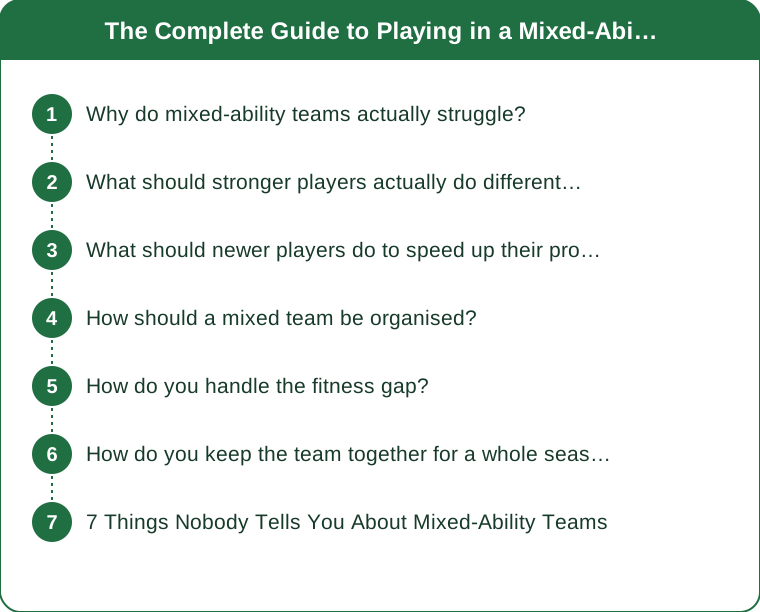
Why do mixed-ability teams actually struggle?
Not because of the skill gap itself, but because of what the gap does to decisions.
Stronger players hold the ball longer, and that breaks the newer players’ timing. An experienced player can carry the ball into pressure and still get out. When the ball then arrives at a newer teammate, it arrives late, under pressure, and in a bad body position. The pass was technically fine and the situation was impossible - and the newer player concludes they are not good enough.
Newer players stop offering themselves. After a few of those, the natural response is to stand further away and stop asking for the ball. Which removes exactly the passing options the team needs and forces the stronger players to hold it even longer. The loop tightens.
Positioning collapses toward the ball. Less experienced players tend to chase, which means everyone ends up in the same third of the pitch and there is nowhere to pass. This is the single most visible symptom of a mixed team not working.
Communication drops as the gap widens. People who feel out of their depth go quiet, and a quiet team makes worse decisions than a loud one regardless of ability.
And the scoreline reinforces all of it. A heavy defeat gets read as a talent problem when it was a structure problem, and the response is usually to give the ball to the good players more - which makes it worse.
The fix runs the other way. Teams that deliberately involve their weakest players improve faster than teams that hide them, because the ceiling of a mixed team is set by its least confident player, not its best one.
What should stronger players actually do differently?
Take less, give earlier, and make the pass that is easy to receive rather than the pass that is clever.
Pass before the pressure arrives, not after. The habit of an experienced player is to let the opponent commit and then release. Against and alongside less experienced players, release earlier - the receiver needs time far more than they need the defender to be beaten.
Pass to the correct foot and the correct side. A ball played to the back foot of a nervous player is a lost ball. Play it to the front foot, away from the nearest defender, with enough weight to reach comfortably - this single habit changes a teammate’s game more than any coaching.
Say what you want before the ball arrives. Turn, man on, time, back. Information delivered a second early is worth more than a perfect pass, and newer players use it far more than experienced ones realise.
Do not fill every space yourself. The instinct of the best player is to go and get the ball. Standing still in a good position and letting a teammate find you teaches them where to look and makes the shape work.
Praise the attempt, not just the outcome. A newer player who tries a forward pass and loses it has done the right thing badly, which is far more useful than the safe backward pass. If the only positive feedback is for successful actions, everyone plays safe and the team gets slower.
And drop the frustration entirely. Visible irritation is the fastest way to make a teammate stop asking for the ball, and a teammate who stops asking makes your own game harder for the next eighty minutes.
What should newer players do to speed up their progress?
Commit to simple actions, get their head up before the ball arrives, and stop trying to be the highlight.
Look before you receive, not after. The single biggest gap between levels is not touch, it is knowing what is around you before the ball gets there. Two glances over your shoulder while the ball is travelling changes everything about the touch that follows.
Choose your action before the ball arrives. Deciding after the first touch is what produces the panicked pass. Even a wrong decision made early is better than a right decision made late.
Master one reliable first touch and use it constantly. A simple touch away from pressure into space, repeated, is worth more in a real game than five techniques you can do in the garden.
Play the pass you can definitely make. A completed five-metre pass keeps the team’s shape and rhythm. A twenty-metre pass that succeeds one time in four gives the ball away three quarters of the time, and the fourth one is remembered by nobody.
Ask for the ball loudly and often. Newer players undercall dramatically. Being available and vocal is a skill that requires no technique at all and it makes you immediately more useful.
Learn your position’s defensive job first. Attacking contribution takes time; positional discipline can be learned in two sessions. A player who is always in roughly the right defensive spot is a genuinely valuable teammate from week one.
And accept that you will lose the ball a lot. Everyone does. The difference is that experienced players lose it in safer places - which is a decision skill, not a technical one, and it is learnable much faster than touch.

How should a mixed team be organised?
By spreading experience rather than concentrating it, and by fixing positions long enough for people to learn them.
Distribute experienced players across the pitch, not into one unit. A back four of experienced players and a forward line of beginners is the worst arrangement - it produces a team that defends well and does nothing else. One experienced player per area of the pitch lifts everyone.
Give newer players a fixed position for at least a month. Rotating people around to be fair means nobody learns the specific patterns of any role. Positional understanding is the fastest available improvement and it needs repetition.
Pair a newer player with an experienced one in the same area. A full back and a winger, two centre backs, a midfield pair. The learning is enormous and requires no formal coaching.
Keep the shape simple. A basic 4-4-2 or 4-3-3 with clear responsibilities beats anything more sophisticated. Complex systems require everyone to understand them, and a mixed team by definition does not.
Set a team rule about the first pass out of defence. Short and sideways to a free player, every time. Removing that one decision prevents most of the chaos that mixed teams experience in their own third.
Rotate substitutions on a timer, not on performance. Deciding who comes off based on how they are playing punishes exactly the people who need minutes most.
And agree what the team is for before the season. A team where half want to win a league and half want a social kickabout will have a difficult year. The conversation is awkward once and miserable weekly if avoided.
How do you handle the fitness gap?
By recognising it is often larger and more consequential than the skill gap, and by training for it separately.
Technique degrades with fatigue faster than anything else. A player whose touch is fine in the first twenty minutes may be a completely different player at sixty. On a mixed team, the second half is where the gap really shows - and it is a conditioning gap, not a skill one.
Match fitness is specific and cannot be built by running alone. Football is repeated sprints with incomplete recovery, and steady jogging prepares you poorly for it. Short intervals - twenty to thirty seconds hard, sixty easy, repeated - transfer far better.
Newer players usually run more, not less. Inefficient positioning means chasing, and chasing costs enormous energy for little benefit. Better positioning is a fitness intervention, and it is the cheapest one available.
Build in genuine substitutions. A mixed team with a thin bench pushes its least conditioned players through ninety minutes, which is where injuries happen. Fatigue is the biggest single injury risk factor in recreational football.
Warm up properly, together, every time. Adult recreational teams routinely skip this and pay for it. Ten minutes of progressive movement, including some sprinting before the whistle, matters more with age and matters most for the least conditioned.
And do something in the week. One session a week outside the game - even twenty minutes of intervals - changes the second half more than any amount of technical practice.
This is general fitness information, not medical advice. Anyone returning to sport after a long gap, an injury, or with a health condition should get proper guidance first.
How do you keep the team together for a whole season?
By managing the social side as deliberately as the football, because that is what actually determines whether people keep turning up.
Attendance is the real competitive advantage in adult football. A team of moderate players who all show up beats a talented squad that fields nine people twice a month. Everything that supports attendance is a football decision.
Newer players quit for social reasons far more often than sporting ones. Feeling like a burden, not knowing anyone, or being the last one picked. Ten minutes of conversation before training does more for retention than any amount of encouragement during the game.
Give everyone meaningful minutes. A player who plays the last eight minutes of every game is not a member of the team, and they will work that out by November.
Debrief briefly and generously. Three minutes after the game, focused on one thing that went well and one thing to try next week. Long post-mortems after defeats drive people away.
Have one non-football thing. A drink afterwards, a group chat that is not just logistics, an occasional meal. Teams with a social layer survive bad runs; teams without one dissolve after three losses.
Watch for the quiet drift. The player who misses two weeks, then a third, is usually deciding rather than busy. A direct message asking them to come to the next one works remarkably often - and almost nobody sends it.
And decide what a good season looks like beyond the table. Everyone improved one specific thing, everyone played, everyone came back next year. Those are achievable, they are within your control, and they are what people actually remember.
7 Things Nobody Tells You About Mixed-Ability Teams
The gap closes faster than anyone expects. A committed beginner playing weekly improves dramatically over a season, while experienced players are largely at their level. The team you have in May is not the team you had in September.
Experienced players get better too, in a different way. Playing alongside less experienced teammates forces earlier decisions, simpler passing, and better communication. Many report it improved their game.
The loudest player is more valuable than the most skilful one. Constant communication compensates for a lot of positional uncertainty, and it is free.
Beginners read the game surprisingly well from the bench. Watching from the side for fifteen minutes teaches positional awareness faster than playing does. A deliberate spell of watching, with something specific to look for, is genuinely useful coaching.
The first touch problem is usually a body position problem. Players blame their feet when the actual issue is that they were square, flat-footed, and facing the wrong way. This is fixable in weeks, not years - which is why it is the highest-value thing a newer player can work on.
Everyone thinks they are the weakest player. Including several people who are visibly not. Saying this out loud at the start of a season defuses an enormous amount of quiet anxiety.
And the reason people stay is almost never the football. It is the Thursday-night habit, the people, and the feeling of being expected somewhere. Protect that and the football takes care of itself.
TL;DR:
- The skill gap is not the problem - the mismatch in decision speed is.
- Stronger players: pass earlier, to the front foot, and talk before the ball arrives.
- Newer players: look before you receive, decide early, and call for the ball loudly.
- Spread experience across the pitch and give newer players a fixed position for a month.
- The fitness gap shows up in the second half and is fixed with intervals, not jogging.
- Attendance is the real advantage - and people stay for the social layer, not the football.
Next session, try one thing: pass a full second earlier than feels comfortable. It changes how the whole team looks.
Keep Reading
This article is for general informational and styling purposes only. Fit, sizing, and product availability may vary.