The Complete Guide to Going in Goal When You Are Not a Goalkeeper
Quick Answer: You do not need goalkeeper technique to have a decent half in goal — you need positioning, a safe way to go to ground, and the discipline to stay big and stay on your feet. Ninety percent of what makes an untrained keeper look bad is standing in the wrong place and diving when they should have stayed standing. Learn the near-post rule, the set position, and the collapse-not-dive save, and you will be fine.
The regular keeper’s car broke down. Someone has to go in, and the way these things work, it is going to be you.

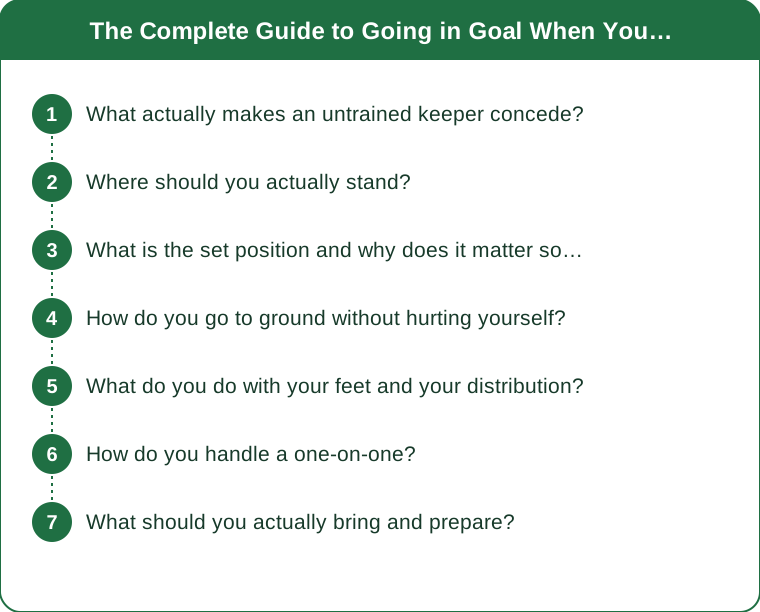
What actually makes an untrained keeper concede?
Almost never reflexes. Almost always position.
Watch any recreational match and the goals that go in past a fill-in keeper follow the same three patterns, and none of them are about hand speed.
Standing on the goal line. This is the instinct — the goal is behind you, so you guard it. A keeper on the line has to cover the entire seven-plus yards of goal from a standing start, and the angle from any shooting position is wide open. Two steps forward cuts the shooter’s visible target dramatically, and it costs you almost nothing on a shot over your head, because at recreational pace those are rare and usually going wide anyway.
Being caught flat-footed. A keeper standing upright with straight legs cannot move in any direction quickly. The set position exists precisely because you cannot push off from a locked knee.
Committing early. Going to ground before the shot is struck, guessing a corner, or rushing out without deciding to. An untrained keeper who stays standing and stays big saves more shots than one who dives spectacularly at the wrong moment — and the diving one also gets hurt more.
The encouraging part of all this is that positioning and stance are learnable in about ten minutes of understanding, whereas actual goalkeeping technique takes years. You can get most of the available benefit before the match starts.
Where should you actually stand?
On the line between the ball and the center of the goal, a step or two off the line, adjusted for distance.
The core principle is the angle bisector. Imagine a line from the ball to each post. Your job is to stand on the line that splits that angle in half, so you are equally far from both sides of the shot. This is what “cutting the angle” means, and it is the single most useful geometric idea in goalkeeping.
How far off the line depends on how far away the ball is:
- Ball at the halfway line: you can be well off your line, near the top of the six yard box. There is time to retreat.
- Ball around the penalty spot: a yard or two off the line. Far enough to narrow the angle, close enough to react.
- Ball inside the six yard box: get big and close, immediately. At that range the shot is faster than your reaction, so you are trying to occupy space rather than react to a shot.
Use the six yard box as your map. Its corners and lines give you reference points, and glancing down for a quarter-second to check where you are is normal, not amateurish.
And learn the near-post rule, which is the one that saves the most embarrassment. When the ball is out wide at an angle, your first job is to cover the near post completely — get your body touching or nearly touching it. A goal at the near post from a wide angle is the one that gets talked about after the match, and it is entirely preventable by standing in the right place.
What is the set position and why does it matter so much?
It is the stance that lets you move, and being in it at the right instant is most of the job.
The set position: feet slightly wider than shoulder width, weight on the balls of your feet, knees bent, hips low, hands up and forward at roughly waist-to-chest height with palms facing the ball. Not hands down by your sides. Not standing tall.
The details matter more than they look:
- Weight forward, not back. You want to be able to fall toward the ball. Weight on your heels means every movement starts with a correction.
- Hands in front of your body, not beside it. Any ball you reach from a hands-forward start arrives sooner.
- Knees bent enough that you could jump. If you cannot jump from your stance, you cannot dive from it either.
The timing is the part nobody tells fill-in keepers. You do not hold the set position continuously — that is exhausting and unnecessary. You get set the moment before the shot is struck, as the shooter’s plant foot lands. Between shots you are moving, adjusting your angle, and staying loose.
A useful drill you can do in warmup: have someone stand fifteen yards out and shoot at a walking pace, over and over, while you practice getting set as their foot plants. Ten repetitions is enough to make it feel less alien, and it is the highest-value ten minutes available to you.
How do you go to ground without hurting yourself?
By collapsing, not diving. This is the most important safety point in the whole guide.
A proper goalkeeper dive is an explosive, trained movement with a specific landing sequence, and attempting it untrained is how outfield players separate shoulders and bruise ribs. You almost never need it at recreational level.
What you want instead is the collapse save. For a ball to your side and low:
- Step toward the ball with the near foot, opening your hips in that direction.
- Let that knee fold so you go down at an angle rather than falling flat sideways.
- Land on the side of your thigh and hip first, then your ribs — not on your elbow, and never on your shoulder point.
- Keep both hands in front of the ball, one behind and one on top if you can.
The key mental adjustment: you are getting low and wide, not launching. For a ball within a step of you, that is all that is required, and it is dramatically safer.
What to avoid entirely:
- Diving at feet in a crowd. Face and hands into a scrum of boots is where the genuinely bad injuries happen. Stay standing and make yourself wide.
- Landing on an outstretched arm. This is the shoulder injury. Keep the trailing arm tucked.
- Going down early on a one-on-one. A standing keeper who spreads and waits forces the shooter to make a decision. A keeper already on the ground is simply not in the way anymore.
For high balls, use the basket catch: hands together forming a W behind the ball, thumbs nearly touching, catching in front of your face where you can see it. If in doubt, do not catch — punch or parry wide. A ball palmed over the bar is a corner. A ball dropped in the six yard box is a goal.
What do you do with your feet and your distribution?
Play it simple, and remember the backpass rule, which is the most common fill-in keeper disaster.
The backpass rule: if a teammate deliberately kicks the ball to you, you cannot pick it up. Doing so gives away an indirect free kick from inside the box, which in a rec match is roughly a goal. Same applies to a deliberate throw-in to you from a teammate. A header back to you is legal to handle in most rulesets — check your league.
So you need a plan for a ball rolled back to you under pressure, and “panic” is not it:
- Take the first touch away from the pressure, not straight ahead.
- The touchline is your friend. Putting it out for a throw-in deep in your own half is a completely acceptable outcome and nobody will criticize you for it.
- Do not attempt the clever pass across your own box. This is the single worst error available to a keeper and it happens to professionals.
For distribution after a save:
- Roll it to a nearby defender if there is no pressure. Accurate and safe.
- Throw overarm for distance. Much more accurate than kicking for most outfield players, and you have six seconds and freedom to move within the box.
- If you must kick, kick it long and toward a touchline, not up the middle. A cleared ball that goes out is fine; a cleared ball to an opponent at the top of the box is another shot.
And communicate constantly. You are the only player who can see the whole field in front of you. “Away!” “Man on!” “Keeper!” — shouting “keeper” when you are coming for a ball is not optional, because a defender who does not hear you will head it into you or into the net.
How do you handle a one-on-one?
Slowly, and by making yourself a problem rather than by making a save.
A one-on-one feels like the moment that demands heroics, and heroics is exactly what loses it. The shooter has all the advantage as long as you are moving toward them at speed — they simply go around you.
The sequence that works:
- Close the distance early, while the ball is still traveling to them. Every yard you gain before they have control is free.
- Then slow down and get set. This is counterintuitive and it is the whole technique. A stationary set keeper is much harder to beat than a charging one.
- Stay standing as long as possible. Force them to commit to a decision. Most recreational players will shoot early when a keeper stays big, and an early shot from an unsettled player is a very savable shot.
- Spread when they touch it past you or when the shot comes. Arms and legs wide, low, covering as much frontal area as you can. This is the star shape, and it works because it blocks the whole low-and-middle band where most of these shots go.
What not to do: do not dive at their feet from distance, do not go to ground before they have shot, and do not try to read which way they are going. Guessing is a coin flip; staying big is closer to sixty-forty in your favor.
And accept the ones you cannot stop. A well-struck shot into the corner from twelve yards beats trained goalkeepers. Your job as the fill-in is to not concede the easy ones, and that is entirely within your control.
What should you actually bring and prepare?
Small list, and most of it prevents injury rather than conceding goals.
Gloves, genuinely. Not for grip — though they help — but because bare hands catching a hard shot on a cold evening is how fingers get sprained and jammed. A basic pair costs very little and lives in your bag for the day you get asked.
Long sleeves and long pants if you have them. You will be going to ground on a surface that is either abrasive or hard, sometimes both. Turf burn on a forearm is entirely preventable and a long-sleeve top is the whole solution.
Warm up differently than you would as an outfielder. Goalkeeping is short explosive movements from a static position into positions your hips and shoulders are not used to. Spend five minutes on hip openers, some lateral shuffles, and a few gentle collapses to each side before the match. Going in cold at halftime with no warmup is the most common way fill-in keepers pull something.
Late summer and early autumn specifics: low evening sun sits directly in a keeper’s eyes at one end of many pitches, so check which end you have and be ready to shield. Wet grass makes low shots skid and bounce unpredictably, which argues for getting your body behind everything rather than reaching with hands. And a pitch that has hardened over a dry August is a much less forgiving surface to land on than the same pitch in spring — another argument for the collapse rather than the dive.
Set your own expectations, and set the team’s. Say out loud that you are not a keeper. It changes how defenders play in front of you, usually for the better, and it removes the pressure that makes people do something reckless in the eighty-fifth minute.
TL;DR:
- Position beats reflexes: stand on the angle bisector, a step or two off your line, and cover the near post from wide balls
- Get set as the shooter’s plant foot lands — feet wide, knees bent, hands up and forward
- Collapse rather than dive: land on thigh and hip, never on an outstretched arm or shoulder point
- Know the backpass rule, throw rather than kick, and shout “keeper” every time you come for a ball
- On one-on-ones, close early, slow down, stay standing, then spread
Nobody expects a fill-in to be good. They expect you to be in the right place and to not get hurt, and both of those are things you can decide before kickoff.
Keep Reading
This article is for general informational and styling purposes only. Fit, sizing, and product availability may vary.