The Complete Guide to Defending When Nobody Ever Taught You How
Quick Answer: Defending is position, patience, and timing - not speed or aggression. The four things that improve it fastest are: stand side-on rather than square, stay an arm’s length plus a bit away rather than diving in, show the attacker to their weaker side, and tackle only when the ball leaves their foot. Almost every recreational defending error is one of those four, and all four are learnable in a few sessions without any change in fitness.
This guide covers the body position, the distances, the decisions, and the specific situations where it goes wrong.

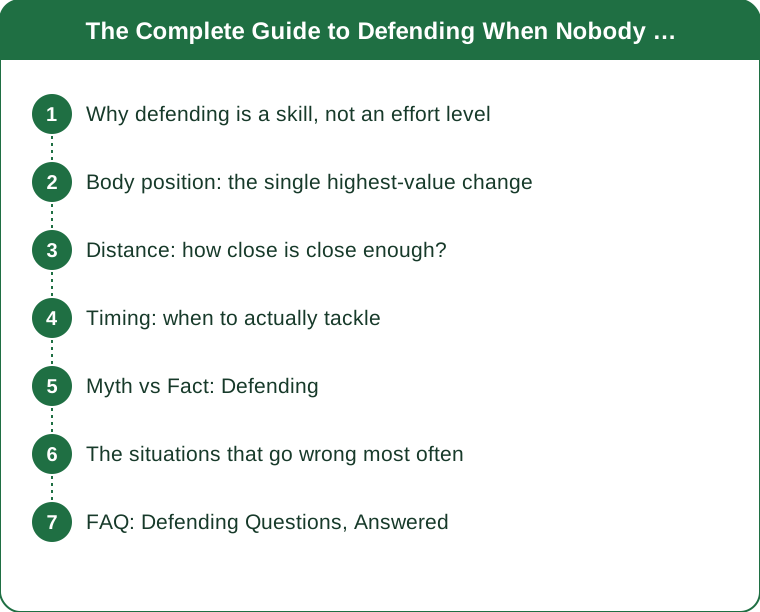
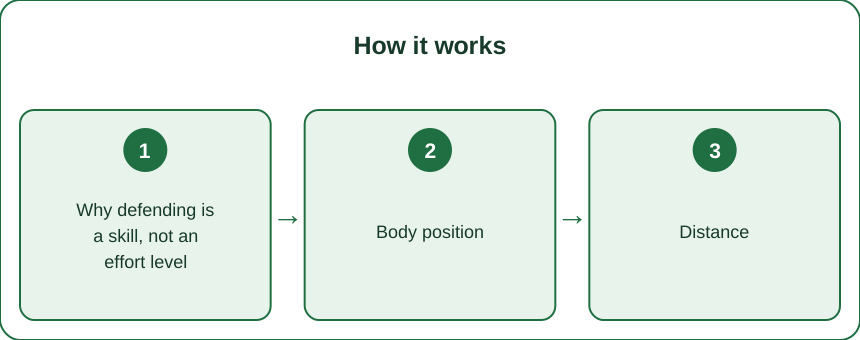
Why defending is a skill, not an effort level
Most recreational players think defending means trying harder. They chase, they lunge, they close down at full speed - and they get beaten repeatedly by attackers who are not especially skilful, because effort without position is easy to play around.
Defending is fundamentally about denying space and time, not about winning the ball. A good defender frequently never touches the ball at all: they make the attacker pass backwards, or take a bad touch, or run into a crowded area. All of those are successful defending and none of them look like anything from the sideline.
The reason nobody taught you is structural. Youth coaching and casual play both emphasise attacking, because attacking is what people enjoy and what gets watched. Defending is taught in organised environments and skipped almost everywhere else - so most adults arrive at recreational football with a large, specific gap.
That gap is unusually easy to close. Attacking skill takes years of touch development. Defending is largely decision-making and body position, both of which improve quickly with explicit instruction. Players who work on it for a month usually see a visible difference, which is not true of first touch.
And it changes what happens to your team, not just to you. One player who stops diving in removes the most common way recreational teams concede - the defender committed, beaten, and the whole shape broken behind them.
The mental shift is the first step. Your job is not to win the ball. Your job is to make the attacker’s next action worse than it would otherwise be - slower, backwards, sideways, or under pressure. Winning the ball is a bonus that arrives when they make a mistake.
Body position: the single highest-value change
Stand side-on, not square. Facing the attacker straight on means you have to turn before you can move, and turning takes a step you cannot afford. Side-on, with one shoulder pointed at them, you can move backwards at speed without turning at all.
Which shoulder decides where they go. Angling your body so one side is open invites the attacker toward that side - and you get to choose which. Show them toward the touchline, toward their weaker foot, or toward your covering teammate.
Stay low with knees bent and weight on the balls of your feet. Standing upright with straight legs means your first movement is slow in every direction. A low athletic stance is the difference between reacting and watching.
Never cross your feet. Move with short side-steps, keeping your feet apart. Crossed feet mean a moment where you cannot change direction, and good attackers are looking for exactly that moment. This is the single most common technical error and it is entirely fixable.
Keep your eyes on the ball, not the attacker’s upper body. Feints work by selling a movement with the shoulders and head. The ball cannot lie - it only goes where it is actually kicked, and watching it makes you almost immune to stepovers.
Practise it without a ball at all. Five minutes of side-stepping in a defensive stance, changing direction on a call, builds the movement pattern faster than any drill involving an attacker - because you can focus entirely on the feet.
And the arm matters more than people admit. A trailing arm gives you awareness of where the attacker’s body is and helps you hold your line legally. Not a push - a feel - and referees at recreational level are generally fine with it as long as it is not extending.
Distance: how close is close enough?
About an arm’s length plus a step, and it varies with the situation. Too close and you can be knocked past with one touch. Too far and they can turn, pass, or shoot freely - which is the more common recreational error.
Close down fast, then slow down. The approach should be quick over the first two-thirds and decelerating over the last third, arriving under control. Sprinting the whole way means arriving with momentum, and momentum is what attackers use against you.
Adjust for their speed. A quick attacker needs more distance because they can accelerate past you. A slower or less confident player can be pressed tighter, and recognising which you are facing within the first two minutes is genuinely useful.
Adjust for the area of the pitch. Near your own goal, closer is necessary because shooting range matters. In midfield, giving a metre more is usually correct because you have cover behind you and time is on your side.
Adjust for whether they are facing you. An attacker with their back to goal can be pressed tight - they cannot go past you without turning. An attacker facing you with the ball at their feet needs more space.
And the direction of their first touch tells you everything. A heavy touch is the moment to press aggressively. A controlled touch close to their feet means hold your position and wait. Reading that one thing correctly is most of good defending.
The practical drill for this is 1v1 in a channel about 5 metres wide and 15 long, with the defender scoring a point for every time they force the attacker backwards or out of the channel - not for winning the ball. That scoring change alone rewires how people defend.

Timing: when to actually tackle
Tackle when the ball leaves their foot, not while it is under control. The moment after a touch is the moment the ball is furthest from them, and that is the only reliably winnable window.
Diving in is the cardinal error. Committing your weight forward means that if you miss, you are out of the game entirely and the attacker has a clear run at whatever is behind you. One defender diving in is how most recreational goals begin.
Delay is a legitimate and often better outcome. Standing up, staying goal-side, and forcing them to hold the ball buys time for teammates to get back - which is usually worth more than a 50/50 tackle attempt.
When you do commit, commit fully. A half-hearted tackle is the worst of both: you lose position and do not win the ball. Decide, then go through the ball with the front foot planted.
Use the poke tackle more than the block tackle. A quick jab at the ball with the front foot, without transferring your weight, lets you recover if you miss. It is the highest-percentage tackle at recreational level by some distance.
Never tackle from behind or with studs up, and be conscious that tackling from the side into a planted leg is where knee injuries happen. The safest tackle is a front-on poke with the ball clearly playable - if you have to reach through the attacker to get it, do not.
And on wet autumn pitches, timing changes. The ball skids and the ground gives way under a planted foot. Extend your distance slightly, favour standing up over sliding, and accept that sliding tackles on soft ground are far more likely to end badly for both players.
Myth vs Fact: Defending
Myth: good defenders are fast. Fact: good defenders are well positioned, which means they rarely have to be fast. Speed compensates for poor position; position removes the need for speed. Plenty of slow players defend excellently.
Myth: your job is to win the ball. Fact: your job is to make the attacker’s next action worse. Forcing a backward pass is a complete success, even though nothing visible happened.
Myth: you should always face the player you are marking. Fact: side-on is almost always correct, so you can move backwards without turning and so you can see both the ball and what is happening behind you.
Myth: being aggressive makes you a better defender. Fact: aggression without patience produces fouls and gets you beaten. The best recreational improvement is usually doing less, later, not more, sooner.
Myth: watching the attacker’s body tells you where they are going. Fact: their body is what is lying to you - that is the entire purpose of a feint. Watch the ball.
Myth: defending is boring. Fact: defending is the fastest area to improve for most adult players, which makes it the most rewarding to work on - visible progress in weeks rather than years.
Myth: if you get beaten, you should have tackled harder. Fact: most beaten defenders committed too early, not too weakly. Getting beaten is usually a timing error, and tackling harder makes the same error more expensive.
The situations that go wrong most often
Being isolated 1v1 with space behind you. The instinct is to press. The correct move is usually to retreat while staying goal-side, slowing them down until help arrives. Backwards is not cowardice, it is the right answer.
Two attackers against you alone. Do not commit to either. Position yourself to delay the ball carrier while blocking the passing lane to the second - a body angle that makes the pass difficult buys the seconds you need.
Defending a cross. Get goal-side and ball-side, attack the ball rather than waiting for it, and head or clear it high, wide, and away from the centre. The most common error is watching the ball flight while standing still.
Marking someone quicker than you. Give more distance and show them toward the touchline rather than the middle. Never let a quicker player get you turned - if they get past your shoulder, you have already lost.
Defending as a team when you have never been coached it. The basic idea is that the whole line moves together, and that whoever is closest presses while the others cover behind and across. A simple rule your team can agree in two minutes: nearest player presses, next nearest covers.
Recovering after being beaten. Do not give up on the play. Run a curved path back toward your own goal rather than chasing directly - you cut off more options and often arrive before the attacker does.
And set pieces are where recreational teams concede most. Decide before the game whether you are marking zonally or man-to-man. The problem is almost never the system; it is that half the team thinks it is one and half thinks it is the other.
FAQ: Defending Questions, Answered
What is the single biggest defending mistake?
Diving in - committing your weight forward while the attacker still has the ball under control. If you miss, you are out of the game and everything behind you is exposed.
Should I watch the ball or the player?
The ball. The attacker’s body movements are designed to deceive you; the ball can only go where it is actually kicked. This makes you largely immune to stepovers and feints.
How close should I stand to the attacker?
About an arm’s length plus a step, adjusted for their speed, which way they are facing, and where you are on the pitch. Closer near your own goal, further in midfield where you have cover.
Is it bad to keep retreating instead of tackling?
No - delaying is often the correct outcome, especially when isolated. It buys time for teammates to recover, and forcing a backward pass counts as successful defending.
How do I defend someone faster than me?
Give more distance, stay side-on, and show them toward the touchline rather than into the middle. Never allow them to get you turned - once they are past your shoulder, pace decides it.
Are sliding tackles worth learning?
Rarely at recreational level, and less so on wet autumn pitches. A standing poke tackle wins the ball more often and leaves you on your feet if you miss.
How long does it take to get noticeably better?
Faster than any other area of the game - most players see a clear difference within three or four sessions of focusing on body position and distance, because it is decision-making rather than touch.
TL;DR:
- Defending is position, patience, and timing - not speed or aggression. It is the fastest-improving area of the game for adults.
- Stand side-on, low, feet apart, never crossed. Facing square costs you a step you cannot afford.
- Arm’s length plus a step. Close down fast, then decelerate over the last third so you arrive under control.
- Tackle only when the ball leaves their foot. The poke tackle beats the block tackle at recreational level.
- Watch the ball, not the body. Feints work on the body; the ball cannot lie.
- Delaying counts as success. Forcing a backward pass is a complete defensive win.
- Team rule to agree in two minutes: nearest player presses, next nearest covers.
On wet autumn pitches, extend your distance and stay on your feet. Sliding on soft ground ends badly for both players.
Keep Reading
This article is for general informational and styling purposes only. Fit, sizing, and product availability may vary.