The Complete Guide to Improving Your First Touch, Not Just Your Shooting
Quick Answer: First touch — the quality of the very first contact with an incoming ball — determines how much time and space a player has for every decision that follows, yet it typically gets far less deliberate practice time than shooting, despite being the more foundational skill for most match situations.
Shooting drills get the highlight reel. First touch quietly determines whether a player ever gets a clean shooting chance in the first place.

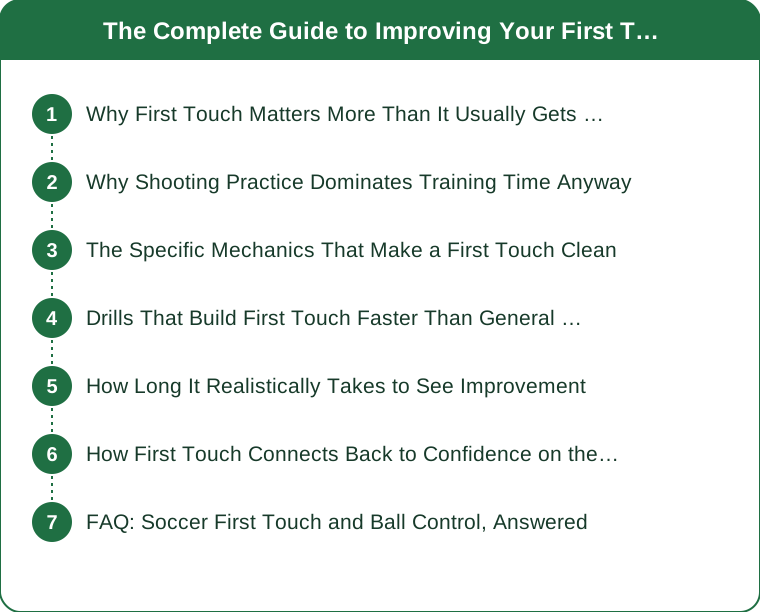
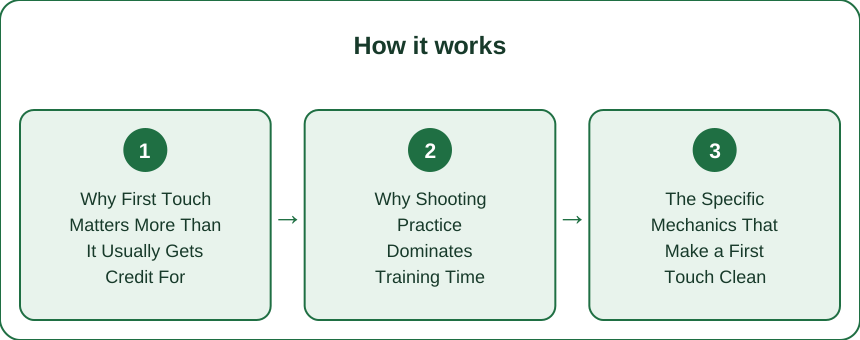
Why First Touch Matters More Than It Usually Gets Credit For
Every meaningful action on a soccer field — a pass, a shot, a dribble — starts with receiving the ball, and the quality of that very first touch determines how much time, space, and balance a player has to execute whatever comes next. A poor first touch that bounces a yard away from the body forces a rushed, often lower-quality second action, while a clean, controlled first touch keeps the ball close and preserves options. This compounding effect is a major reason experienced coaches often rate first touch as more predictive of overall playing quality than raw shooting power, even though shooting gets disproportionately more attention in casual training.
Why Shooting Practice Dominates Training Time Anyway
Shooting is visually rewarding and immediately measurable — a ball either goes in the goal or it doesn’t, which makes it a naturally appealing focus for both structured training and informal practice. First touch improvement is more incremental and less visually dramatic, since success looks like the ball simply staying close and controlled rather than a clear scoring outcome, which makes it easy to underinvest in relative to its actual importance to overall play.
The Specific Mechanics That Make a First Touch Clean
A good first touch usually involves subtly cushioning the ball on contact — moving the receiving surface (foot, thigh, or chest) slightly backward at the moment of contact to absorb pace, rather than leaving a rigid surface for the ball to bounce off unpredictably. Body positioning before the ball even arrives matters just as much: angling the body to see both the ball and the field ahead, rather than receiving square-on with your back to open space, sets up what happens immediately after the touch.

Drills That Build First Touch Faster Than General Play
Wall passing at varying distances and paces forces repeated, rapid touch-and-control repetitions in a short period, which builds the specific muscle memory general scrimmage play doesn’t provide nearly as densely. Receiving passes while under light, controlled pressure from a partner — even just shadowing without real contact — builds the decision-making layer that game-realistic first touch actually requires, since a clean touch with no pressure doesn’t fully translate to game situations.
How Long It Realistically Takes to See Improvement
Consistent, focused first touch practice — even just 15-20 minutes a session, a few times a week — tends to show noticeable improvement within several weeks for adult beginners, since the skill is more about repetition-built feel than raw athleticism, making it one of the more approachable skills to improve deliberately regardless of starting point or age.
How First Touch Connects Back to Confidence on the Field
For newer or returning players specifically, a reliable first touch reduces the split-second panic of an incoming ball, which has a real effect on overall confidence and willingness to get involved in play rather than avoiding the ball out of uncertainty. This confidence effect is often underestimated as a benefit of first touch training, since it’s not purely a technical skill — it changes how comfortable a player feels wanting the ball in the first place.
FAQ: Soccer First Touch and Ball Control, Answered
Should beginners practice first touch with both feet or focus on their dominant foot first?
Both feet from early on is generally recommended, since game situations don’t wait for a preferred foot to be available, though it’s reasonable to spend slightly more repetitions on the weaker foot to close the gap faster.
Does first touch training require a partner, or can it be done solo?
Much of it can be done solo using a wall or rebounder, making it one of the more accessible skills to train without needing a full team or partner present.
Is first touch improvement noticeably different for adult beginners compared to youth players?
Adults often actually improve first touch skills relatively efficiently since the underlying coordination and body awareness are already developed — the skill itself is more about targeted repetition than youth-specific athletic development.
TL;DR:
- First touch quality determines the time and space available for every action after it
- Shooting gets disproportionate practice attention relative to its actual importance
- Cushioning contact and pre-touch body positioning are the core technical elements
- Wall passing and light-pressure receiving drills build first touch faster than scrimmage alone
- Noticeable improvement is realistic within weeks of consistent, focused practice
Investing practice time in first touch pays off in every other part of the game, not just its own drills.
Keep Reading
This article is for general informational and styling purposes only. Fit, sizing, and product availability may vary.