The Complete Guide to Returning to Soccer After Years Away
Quick Answer: Technical skill returns fast, match fitness returns slowly, and tissue tolerance returns slowest of all — which is why returning players are strongest in week two and injured in week six. A workable return runs over eight to twelve weeks: three weeks of running and change-of-direction preparation before any football, then small-sided games, then full matches. The hamstring and calf injuries that end most comebacks are almost entirely preventable with that sequence.
You played until you were twenty-two and then life happened. Now there is a Sunday league or a casual side, and the first touch that came back in ten minutes made you think this would be easy.
It is not easy, but it is very manageable — if you respect the order in which things return.

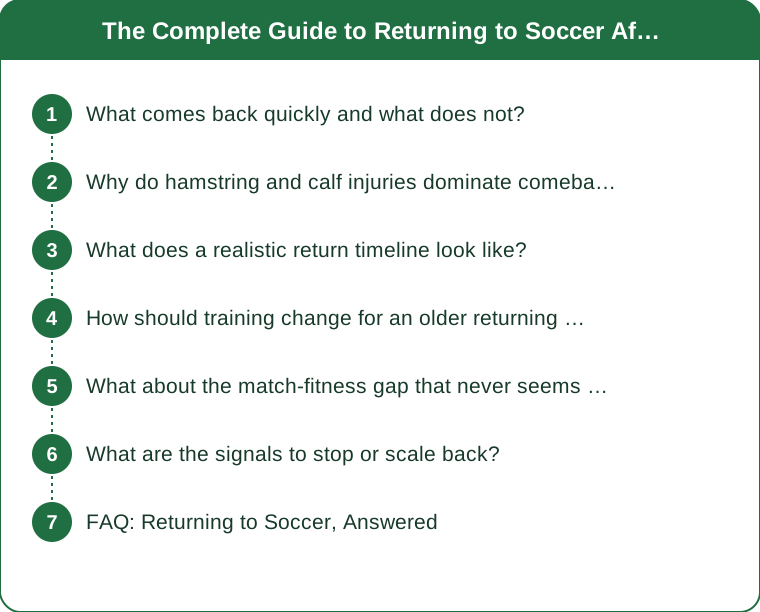
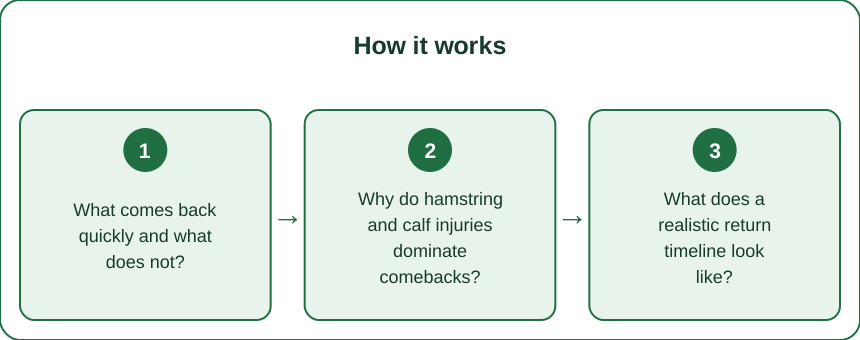
What comes back quickly and what does not?
The gap between these two lists is the entire problem with football comebacks.
Comes back within two or three sessions: first touch, passing weight, the ability to read where the ball is going, positional instinct, and most of the technical vocabulary you built as a younger player. Motor patterns learned to a high level are extraordinarily durable — this is why someone who has not played in fifteen years can still control a ball out of the air within a few attempts.
Comes back over four to eight weeks: aerobic base, the ability to repeat efforts, and general leg strength. These respond well to consistent work and progress predictably.
Comes back over three to six months: the specific tissue tolerance football demands. Hamstrings at high sprint velocity. Calf and Achilles under repeated push-off. Groin under lateral loading and kicking. Ankle stability during sudden deceleration. These adapt slowly at every age and considerably more slowly after thirty.
May not come back at all without deliberate work: top-end sprint speed and the reactive change-of-direction ability that comes from years of continuous exposure.
The trap is obvious once stated. Your technical ability writes cheques your tissue cannot cash. You can put the ball in the corner from thirty yards in week two, and the muscle that generates that strike has not done anything like it in a decade. This is why returning players get injured doing something they can clearly still do.
Why do hamstring and calf injuries dominate comebacks?
Because football’s demands on them are unlike anything in ordinary life or general fitness.
Hamstring strains in football occur overwhelmingly during high-speed running, specifically in the late swing phase when the muscle is lengthening while contracting hard to decelerate the lower leg. That is an eccentric load at high velocity, and it is essentially impossible to replicate by jogging, cycling, or gym work at moderate intensity.
So a returning player can build a genuinely good aerobic base over six weeks and still have hamstrings entirely unprepared for the first real sprint. The first sprint typically arrives in a match, unplanned, chasing a ball — at maximum effort, cold, in week five.
Calf and Achilles injuries follow a similar logic. Football involves thousands of push-offs, many from awkward positions, on a surface with variable grip. Achilles tendon adapts over months, and a tendon that has done ten years of walking is not ready for ninety minutes of accelerating.
The two protective interventions with the strongest evidence behind them are unglamorous and widely skipped:
- Nordic hamstring curls, or an equivalent eccentric hamstring exercise, done twice weekly. The reduction in hamstring injury rates in studies of football populations is substantial.
- Progressive exposure to high-speed running before matches, so the first maximum sprint happens in a controlled session rather than in a game.
Both need to be in place before you play, not started after the first twinge.
What does a realistic return timeline look like?
Twelve weeks, structured in four phases. It can be compressed to eight if you have maintained general fitness, and it should be extended if you have not.
Weeks 1-3: running and movement preparation, no football. Three sessions a week. Easy continuous running building to 25-30 minutes. Add two sessions of change-of-direction work — simple shuttles, figure-of-eights, gentle cutting at maybe 60% effort. Start Nordic curls and calf raises now, twice a week. This phase feels like a waste of time and is the phase that prevents the injury.
Weeks 4-6: introduce football and high-speed running. Add one small-sided session a week — five-a-side or a training session, not a match. Separately, add strides: 6-8 runs of 40-60 metres building to roughly 80-90% of your top speed. This is where the hamstring meets high velocity in a controlled setting for the first time.
Weeks 7-9: first matches, partial minutes. Play 30-45 minutes, not 90. This is the single hardest instruction to follow and the most valuable. Continue the strength work and the strides — do not drop them once matches start, which is what almost everyone does.
Weeks 10-12: build toward full matches. 60 minutes, then 75, then full. Keep two strength sessions a week indefinitely.
Throughout: one full rest day after every match, and no more than two football sessions in any seven-day period until week ten.

How should training change for an older returning player?
Several things that were optional at twenty are not optional at thirty-five or forty-five.
Warm-ups become genuinely necessary rather than a formality. A proper 15-20 minute warm-up including progressive running speed, dynamic mobility and a few near-maximum efforts before kick-off is the difference between a hamstring that is ready and one that is not. The structured warm-up protocols developed for football have consistently reduced injury rates, and they work because of the progressive speed element, not the stretching.
Recovery time doubles. A 48-hour gap between hard sessions at twenty becomes 72 or more later. Playing Saturday and training Tuesday is fine; playing Saturday and Sunday is how people end up out for a month.
Strength work is not optional. Two sessions a week covering hamstrings, calves, glutes and adductors. This is the single highest-return use of an hour for a returning player, and it is the thing that gets dropped first.
Sleep becomes a performance variable you can feel. The relationship between a bad night and a poor, injury-prone session is much more obvious than it was at twenty.
Position may need to change. Playing where you played at twenty-two is not always the right call. Moving from wide to central, or from midfield to defence, reduces the volume of high-speed running dramatically while keeping everything technical you still have. Plenty of returning players enjoy the game more after this switch and never go back.
Manage the ego on day one. The most common injury in returning football is sustained in the first session by someone attempting something they could definitely do fifteen years ago. Everyone knows this and almost everyone does it anyway.
What about the match-fitness gap that never seems to close?
This is the complaint that persists longest, and it has a specific cause.
Football fitness is not aerobic fitness. It is the ability to repeat high-intensity efforts with incomplete recovery — a sprint, twenty seconds of jogging, another sprint, a jump, a rapid change of direction. A player can run 10k comfortably and still be blowing after fifteen minutes of a match, because the aerobic base has been built and the repeated-sprint capacity has not.
The training that closes this gap is interval work with short, incomplete recovery, ideally with change of direction included. For example: 15 seconds at high intensity, 15 seconds rest, repeated 12-15 times, two or three sets. Small-sided games are the most enjoyable version of the same stimulus and are why they feature so heavily in modern training.
Steady-state running builds the base that allows recovery between efforts and is worth doing — it is simply not sufficient on its own.
There is also a decision-making component that is genuinely fatigue-sensitive. Late in matches, returning players describe their touch and their choices deteriorating together. That is not coincidence: cognitive performance drops with fatigue, and football decisions are cognitive. The fix is the same — more exposure to making decisions while tired, which small-sided games provide and running does not.
Expect the gap to close over roughly twelve weeks of consistent playing, and expect it to feel much slower than the technical return did.
What are the signals to stop or scale back?
Distinguishing normal comeback discomfort from a developing problem.
Normal: general muscle soreness for 24-48 hours after playing, particularly in quads and calves. Stiffness the morning after. Feeling significantly more tired than the session seemed to justify.
Scale back: soreness that is still present at 72 hours. Soreness that is worse after the second match than after the first. A specific area that is consistently sore while everything else recovers.
Stop and get it assessed: any sharp pain during a sprint, particularly in the back of the thigh. Pain that makes you change how you walk or run. Swelling. A specific point that is tender to press. Any sensation described as a pop, a snap, or a tear — that is not something to run off.
Achilles pain in the morning that eases with movement is the classic early tendinopathy pattern and is worth acting on early, because it is far easier to manage in week one than in month three.
Groin pain that appears when kicking or changing direction similarly rewards early attention.
The general principle for a returning player: an injury caught at the niggle stage costs a week; the same injury played through costs two months. Returning players are unusually prone to playing through, because the season is short, the side is short of numbers, and there is a feeling of having only just got back.
This is general information, not medical advice. If you have a previous significant injury, a cardiac history, or you have been inactive for a long period, get cleared by a GP before starting — and get any suspected muscle tear assessed properly rather than self-managing it.
FAQ: Returning to Soccer, Answered
How much does age actually matter?
Less for technical ability than people fear, and more for tissue recovery than they expect. Plenty of people play well into their fifties and sixties. What changes is not capability but the margin for error — the same training mistake that cost you three days at twenty-two costs three weeks later, so the planning matters more even though the ceiling is still high.
Should I play indoor or outdoor first?
Outdoor small-sided is usually the gentler introduction. Indoor five-a-side involves very frequent changes of direction on a hard surface with high grip, which is demanding on calves, Achilles and knees — it is excellent training once you are established and a fairly aggressive starting point for someone in week one.
What if I can only train once a week?
Then play less, not more. One football session a week plus two short strength sessions at home is a sustainable pattern that keeps you playing. One football session a week plus a competitive match, with no other preparation, is the highest-injury-rate pattern there is — it is the classic Sunday league profile and the reason those leagues have so many long-term absences.
TL;DR:
- Technique returns in days, aerobic fitness in weeks, tissue tolerance in months — injuries happen in the gap.
- Hamstring and calf injuries dominate because high-speed running cannot be prepared for by jogging or gym work.
- Run for three weeks before touching a ball, add strides in weeks 4-6, play partial minutes in weeks 7-9, full matches from week 10.
- Nordic hamstring curls twice weekly and a proper progressive warm-up are the two highest-value protective habits.
- Match fitness is repeated-sprint capacity, not aerobic capacity — intervals and small-sided games close that gap, steady running does not.
The encouraging part is that almost everything you built as a younger player is still there, stored more durably than you would expect. The frustrating part is that the storage is in your nervous system rather than your tendons, and the twelve weeks it takes for the rest of you to catch up is the whole difference between a comeback that lasts a decade and one that ends in October.
Keep Reading
This article is for general informational and styling purposes only. Fit, sizing, and product availability may vary.