The Complete Guide to Fixing a First Touch That Keeps Losing You the Ball
Quick Answer: A first touch that consistently loses possession usually comes from stopping the ball dead instead of directing it into your next movement — training a “touch with purpose” habit, where every first touch sets up your very next action, fixes this faster than isolated ball-control drills alone.
Your shooting is decent, your passing is fine, but the ball keeps bouncing off your foot at the exact moment pressure arrives. That single moment is quietly costing you more than any other part of your game.

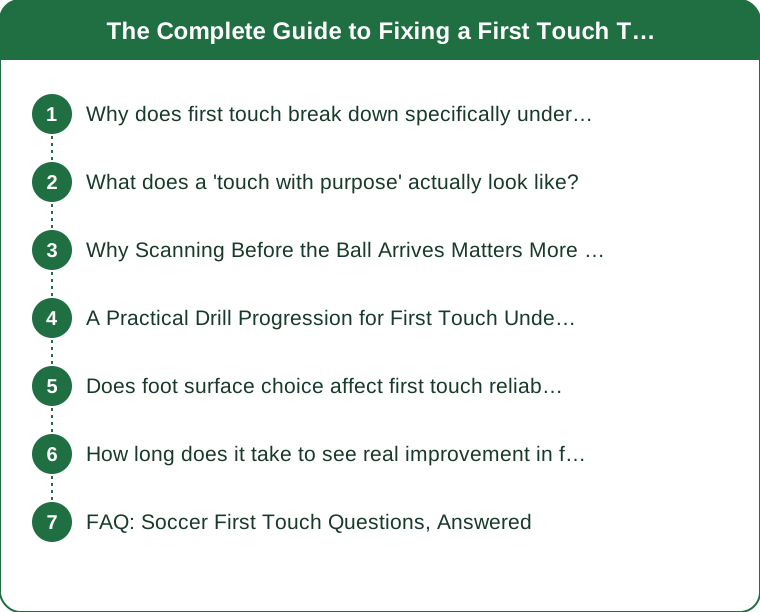
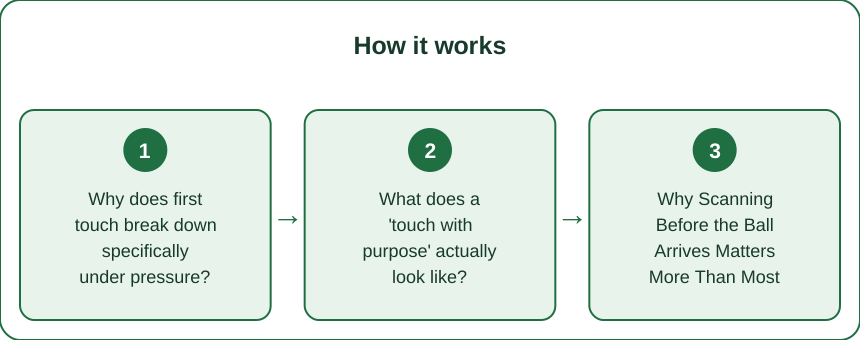
Why does first touch break down specifically under pressure?
In low-pressure practice, a stopping touch (killing the ball dead under your foot) works fine because there’s time to reset before your next action. Under real match pressure, that same stopping touch gives a defender an extra half-second to close you down, which is often exactly enough time to force a turnover.
The technical skill isn’t usually the problem — most players who struggle with first touch under pressure can control a ball perfectly fine in an empty gym. The gap is between practiced conditions and match conditions, which is a training design problem more than a raw skill problem.
What does a ‘touch with purpose’ actually look like?
Instead of receiving the ball and stopping it, then deciding what to do next, a purposeful first touch directs the ball into space away from the nearest defender in the same motion as receiving it — effectively combining the touch and the first step of your next action into one movement. This cuts out the vulnerable “decision pause” that a stopping touch creates.
Practicing this requires deciding your next action before the ball arrives, based on scanning the field just before receiving — a habit that’s as much about vision and anticipation as it is about foot technique.
Why Scanning Before the Ball Arrives Matters More Than Most Players Realize
Elite players are frequently observed checking over their shoulder or scanning the field in the second or two before receiving a pass, gathering information about defender position and open space that informs the direction of their first touch before the ball even arrives. Players who only look up after receiving the ball are working with outdated information and reacting a beat too late.
This scanning habit can be trained deliberately in low-pressure practice — consciously checking your surroundings every few seconds even without the ball, building the habit until it happens automatically during match play without needing to consciously remind yourself.

A Practical Drill Progression for First Touch Under Pressure
Stage 1: Wall passes with a directional touch — receive and redirect the ball at an angle rather than stopping it, repeated until it feels automatic. Stage 2: Add a passive defender jogging toward you as you receive, forcing a quicker decision without full pressure. Stage 3: Add live, competitive pressure from a real defender, applying the directional touch habit built in the earlier stages under real resistance.
Skipping straight to stage 3 without building the underlying habit in stages 1 and 2 is a common reason players plateau — the technique needs to be automatic before pressure is added, not learned simultaneously with pressure.
Does foot surface choice affect first touch reliability?
Yes — the inside of the foot offers the largest, most controllable surface for a directional first touch and should be the default for most receiving situations, while the outside of the foot or a instep touch are situational tools for specific angles rather than a primary technique. Overusing the outside-of-foot touch, which looks flashier, is a common source of inconsistency for developing players who haven’t yet built a reliable inside-of-foot foundation.
Spending disproportionate practice time on the reliable inside-of-foot touch, even though it’s less visually impressive than trick-style touches, builds the consistent foundation that actually holds up under match pressure.
How long does it take to see real improvement in first touch under pressure?
With consistent, purposeful practice (not just general ball-touching time), many players notice a meaningful difference within 4-6 weeks, particularly once the scanning habit and directional touch are being practiced together rather than in isolation. Improvement compounds — each week of built habit makes the next week’s pressure training more effective, rather than progress being purely linear.
Match performance often lags slightly behind training performance by a few weeks, since translating a drilled habit into instinctive match behavior under real pressure and fatigue takes additional repetition beyond the training ground alone.
FAQ: Soccer First Touch Questions, Answered
Is first touch more about technique or decision-making?
Both, but decision-making (via scanning before the ball arrives) is the more commonly underdeveloped half for players who already have reasonable technical ability.
Should beginners focus on inside-of-foot touches before anything else?
Yes — it’s the most reliable, versatile surface and provides the strongest foundation before adding other touch types.
How often should first-touch drills be practiced to see improvement?
Several short, focused sessions per week, combined with conscious scanning practice even without the ball, tends to produce faster results than occasional long sessions.
TL;DR:
- A stopping touch gives defenders time to close down; a directional touch removes that window
- Scanning the field before the ball arrives is as important as the touch technique itself
- Build the directional touch habit in low-pressure drills before adding live defensive pressure
- The inside of the foot is the most reliable surface for most receiving situations
- Expect meaningful improvement within 4-6 weeks of consistent, purposeful practice
At your next training session, focus on one thing only — directing your first touch away from where a defender would be — and let everything else follow from that single habit.
Keep Reading
This article is for general informational and styling purposes only. Fit, sizing, and product availability may vary.