Building a Home Strength and Conditioning Program for Adult Soccer Players
Quick Answer: A solid at-home program for adult soccer players covers four pillars — lower body strength, lateral and rotational movement, aerobic base conditioning, and injury-prevention work for the hamstrings, groin, and ankles — spread across 3 sessions a week outside of regular practice or games.
Most rec league players spend all their training time touching a ball and none of it building the physical base that actually determines whether they’re still moving well in minute 75. A structured off-ball program doesn’t need a gym membership or fancy equipment — it needs a plan and 30-40 minutes, three times a week.
This breaks the program down pillar by pillar, with specific exercises, sets, and reps you can start using this week, plus the reasoning behind why each piece matters specifically for adult recreational players rather than a generic athletic population that doesn’t share the same recovery constraints or training frequency.
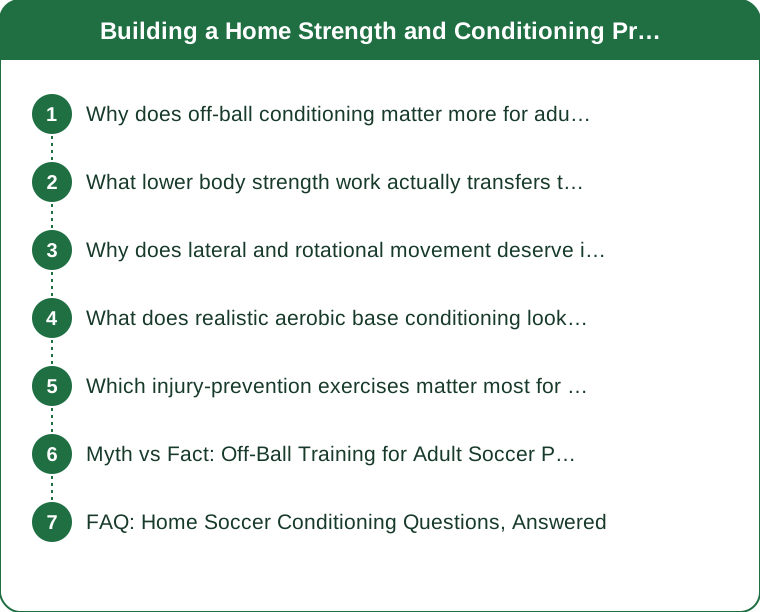
Why does off-ball conditioning matter more for adult players than younger athletes?
Adult recreational players typically train and play far less frequently than younger competitive athletes, which means the general fitness base that used to come from daily practices simply isn’t there anymore. On top of that, recovery capacity declines with age, so the same weekend-warrior pattern of playing hard once a week with zero structured training in between creates a much higher injury risk than it did a decade earlier.
A dedicated conditioning program fills exactly this gap — it rebuilds the aerobic base, strength, and movement quality that used to come automatically from more frequent play, without requiring more games or practices than your schedule already allows.
There’s also a tissue-tolerance angle that’s easy to overlook. Muscles, tendons, and connective tissue adapt to the specific loads they’re regularly exposed to, and a body that only sprints, cuts, and strikes a ball once a week has very little accumulated tolerance built up for those exact demands. Two or three off-ball sessions a week gradually raise that tolerance, so the sprint in minute 10 of Sunday’s match isn’t the first hard sprint your hamstrings have seen since the previous game — which is precisely the pattern behind a large share of adult league soft-tissue injuries.
What lower body strength work actually transfers to the field?
Single-leg strength work transfers best, since soccer is fundamentally a single-leg sport — you’re planting, cutting, and striking off one leg at a time far more than you’re using both legs together. Bulgarian split squats, single-leg Romanian deadlifts, and step-ups build the specific stability and force production that shows up directly in cutting and acceleration on the field.
Aim for 2-3 sets of 8-10 reps per leg, twice a week, progressing load or difficulty gradually. Bodyweight versions work fine to start; adding a backpack with books or household weights is a reasonable way to progress without buying equipment.
Don’t skip the plant leg during shooting or passing drills either — a lot of strength programming focuses on the kicking leg and forgets that the stabilizing leg absorbs significant force on every single strike. Single-leg calf raises and single-leg glute bridges, done for 2 sets of 12-15 reps, specifically build that stabilizing capacity and are easy to fold into a warmup rather than needing their own dedicated block of time.
A reasonable 8-week progression looks like this: weeks 1-2, bodyweight single-leg movements focused purely on balance and control; weeks 3-5, add light external load (a backpack, dumbbells, resistance bands) while keeping the same rep ranges; weeks 6-8, increase load further while adding a small pause at the bottom of each rep to build strength through the exact range of motion a hard cut or tackle demands. Rushing this progression is the most common way people end up sore or discouraged in week two and quietly abandon the whole program.
Why does lateral and rotational movement deserve its own category?
Soccer almost never moves in a straight line — cutting, shielding, and changing direction all happen laterally and rotationally, yet most home workout routines (and most gym programs generally) are built almost entirely around forward-and-back movement patterns like squats and lunges. This mismatch is a major, often-overlooked contributor to groin and hip injuries in adult players whose bodies simply aren’t prepared for the multi-directional demands of the actual sport.
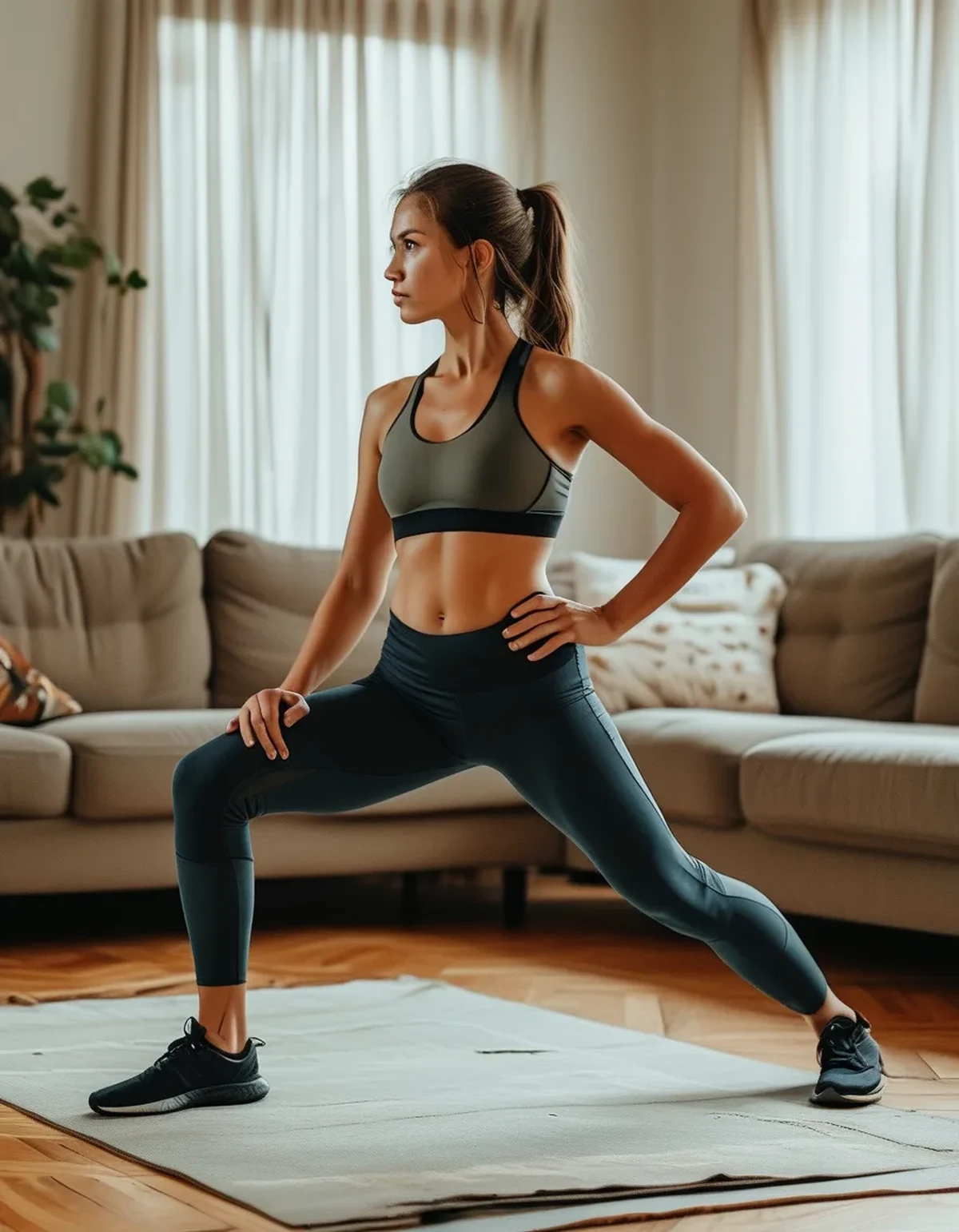
Lateral lunges, lateral bounds, and rotational medicine ball throws (or a weighted household object if you don’t have one) directly train this missing pattern. Two sets of 10-12 reps per side, worked into your regular routine, meaningfully closes this gap over a few months.
A simple test can reveal how big this gap actually is for you personally: try five controlled lateral bounds off one leg, landing and sticking each one for a full second before the next rep. Most players who’ve only trained straight-line movement notice real wobble or a lack of control on landing, especially on their weaker side — that instability is exactly the kind of thing that turns an ordinary sidestep during a match into a rolled ankle or a strained adductor.
Rotational power deserves separate attention from lateral movement, since striking a ball and shielding an opponent both rely on trunk rotation generating force through the hips and core, not just the legs. A standing rotational throw with a light medicine ball, or even a towel twisted and pulled against resistance, trains this rotational chain in a way that squats and lunges simply don’t touch, regardless of how heavy you load them.

What does realistic aerobic base conditioning look like without a track or field?
You don’t need a full field to build a soccer-relevant aerobic base — interval work on any open stretch of ground or even a treadmill covering repeated efforts of 30-60 seconds at a hard pace followed by equal or slightly longer recovery mimics the stop-start demand pattern of an actual match far better than steady-state jogging alone.
A simple weekly structure: one longer steady effort (20-30 minutes at a conversational-but-challenging pace) for aerobic base, and one interval session (6-10 rounds of 30 seconds hard, 60-90 seconds easy) for match-specific conditioning. This combination covers both ends of what a 90-minute match actually demands.
If outdoor space is limited, a stairwell or a set of park stairs works just as well as a treadmill for the interval portion, and arguably better, since the added resistance of climbing builds leg strength alongside the cardio benefit. Whichever surface you use, the goal of the interval session is repeated hard efforts with incomplete recovery — not a single all-out sprint followed by a long rest — since that pattern more closely matches how work rate actually fluctuates during 90 minutes of real match play.
Track your interval performance loosely over time — even something as simple as noting how many rounds you complete before your pace noticeably drops off gives you a rough marker of progress. Most adult players see a meaningful improvement in their ability to sustain repeated hard efforts within 6-8 weeks of consistent twice-weekly interval work, which typically shows up on the field as feeling less gassed during the last 15-20 minutes of a match, exactly the stretch of a game where fatigue-related mistakes and late injuries tend to cluster. Warming up with 5 minutes of light jogging and dynamic movement before either the steady effort or the interval session also matters more as training frequency increases, since it primes the same tissues that will be doing repeated hard work minutes later.
Which injury-prevention exercises matter most for adult players specifically?
Nordic hamstring curls (or a household towel-assisted variation) are one of the most well-supported exercises for reducing hamstring strain risk, which is consistently one of the most common soccer injuries at the adult recreational level. Copenhagen planks (a side plank variation with your top leg elevated) target the adductors, addressing the groin strain risk that comes from the sport’s heavy lateral demand discussed earlier.
Ankle stability work — single-leg balance holds, progressing to single-leg balance on an unstable surface like a folded towel — rounds out the three highest-value injury-prevention movements for this specific sport and age group. Two sets of each, twice weekly, is enough to make a real difference without turning into its own separate workout.
Start Nordic curls and Copenhagen planks at a genuinely easy regression if you’ve never done them before — a partial-range Nordic curl or a bent-knee Copenhagen plank still builds real capacity in these tissues without inviting the soreness that comes from jumping straight to the full, advanced version. Progress the range of motion gradually over several weeks; this is one area where patience pays off directly in fewer missed games from a pulled hamstring or groin later in the season.
It’s worth noting these three exercises specifically because research on adult and semi-professional soccer populations has repeatedly flagged hamstring, groin, and ankle injuries as the most common non-contact issues in the sport, far more than knee or shoulder problems. Building your limited weekly training time around the injuries that are statistically most likely, rather than a generic full-body routine, is simply a better use of 30-40 minutes for a soccer-specific goal.
Myth vs Fact: Off-Ball Training for Adult Soccer Players
Myth: If you play every weekend, that’s enough conditioning on its own. Fact: Playing builds skill and match fitness, but rarely builds the underlying strength and movement quality needed to reduce injury risk — those need dedicated, separate work.
Myth: Strength training will make you slower or less mobile on the ball. Fact: Properly programmed strength work, especially single-leg and rotational patterns, tends to improve acceleration and change-of-direction speed rather than hinder it.
Myth: You need a gym to build real soccer-specific strength and conditioning. Fact: Bodyweight progressions, household objects, and open outdoor space cover the large majority of what an effective adult rec league program actually needs.
Myth: Stretching before a match is all the injury prevention you need. Fact: Static stretching alone doesn’t build the strength or movement capacity that actually reduces strain risk — a proper dynamic warmup plus the ongoing strength work covered above does far more than pre-game stretching by itself, and research on warmup protocols has generally shifted toward dynamic, movement-based preparation over long static holds before intense activity.
FAQ: Home Soccer Conditioning Questions, Answered
How many days a week should an adult rec league player train off the ball?
Three sessions of 30-40 minutes, spread across the week outside of game days, is a realistic and sustainable target for most adult schedules.
Is it too late to start this kind of program if I’ve played injury-free for years?
No — conditioning work is protective regardless of past injury history, and building it in proactively is far easier than starting after an injury forces the issue.
Should this replace touches on the ball, or go alongside them?
Alongside — this program addresses the physical base that supports your ball skills, not a replacement for technical practice, which still matters just as much for actual game performance.
How soon should I expect to notice a difference in how my body feels during matches?
Most players notice reduced post-match soreness and better late-game leg freshness within about 4-6 weeks of consistent training, though the injury-prevention benefit builds gradually over a full season rather than showing up as an immediate, dramatic change.
What equipment is actually worth buying if I want to progress this program over time?
A set of resistance bands and one or two adjustable dumbbells cover almost everything needed to progress all four pillars for well over a year — a full home gym setup isn’t necessary for a program built around bodyweight and light external load, which is exactly what makes it realistic to actually stick with alongside a busy adult schedule.
TL;DR:
- Adult players need dedicated off-ball training to replace fitness that used to come from more frequent play
- Single-leg strength work transfers directly to cutting and acceleration on the field
- Lateral and rotational movement is a commonly missing piece in generic home workouts
- Aerobic interval work should mimic the stop-start pattern of a real match, not just steady jogging
- Nordic curls, Copenhagen planks, and ankle stability work are the highest-value injury-prevention additions
Thirty minutes, three times a week, off the ball is often the difference between playing your best soccer at 35 and watching from the sideline with a hamstring strain. Start with whichever pillar addresses your biggest current weak spot, and build the rest in gradually over the following weeks rather than trying to add all four at once. This is general information, not medical advice.
Keep Reading
This article is for general informational and styling purposes only. Fit, sizing, and product availability may vary.