The Complete Guide to Joining an Adult Recreational Soccer League as a Beginner
Quick Answer: Adult rec leagues are far more beginner-friendly than most people expect — most divisions are explicitly designed for mixed skill levels, and the biggest barrier is usually confidence, not actual soccer ability. A few weeks of basic ball-touch practice and understanding league structure beforehand makes the first game far less intimidating.
The idea of showing up to your first adult soccer game as a beginner can feel more intimidating than it actually turns out to be — most rec leagues are built around welcoming a wide range of skill levels, not filtering for former club players.

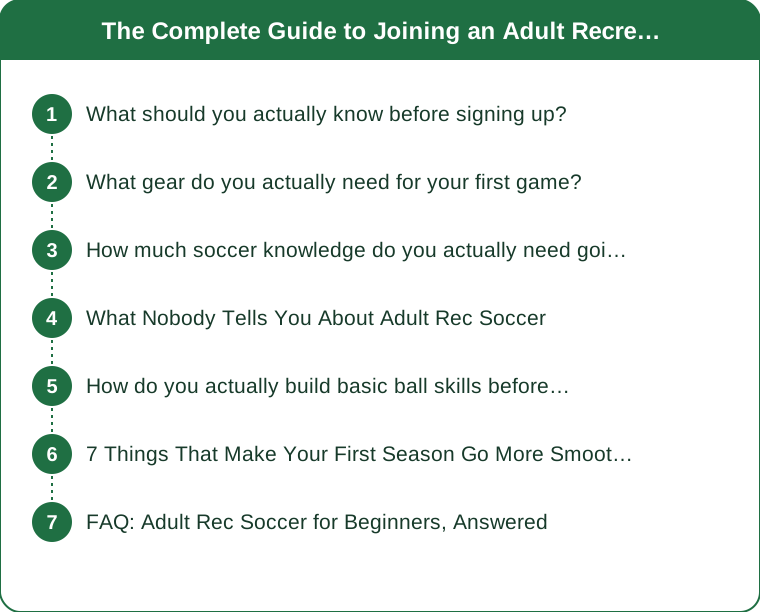
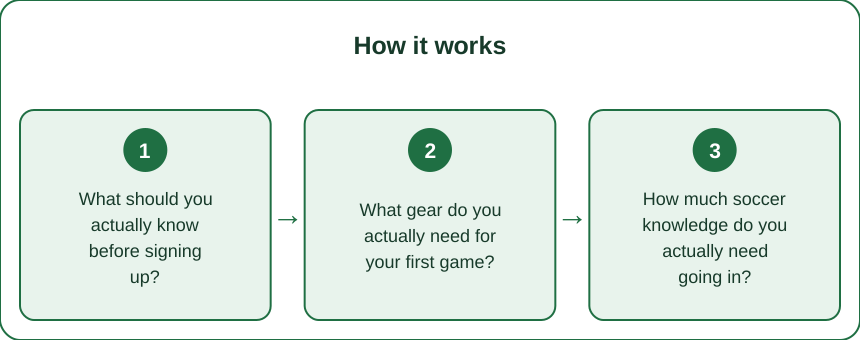
What should you actually know before signing up?
Rec leagues are typically organized by division (often labeled beginner, intermediate, competitive, or coed vs. women’s) — read the division description carefully, since “beginner” divisions genuinely mean it and are full of people in exactly your position. Team-based leagues let you join with friends; individual sign-up leagues place you on a team, which is actually a good option for meeting people if you’re new to the area or sport.
Most leagues run 8-12 week seasons with one game per week, sometimes with a weekly practice — a manageable, low-pressure commitment rather than a major time investment, and a good way to test whether you enjoy it before committing further.
What gear do you actually need for your first game?
Cleats (turf or firm-ground depending on your league’s field type — check before buying), shin guards, and athletic socks long enough to cover the shin guards fully are the non-negotiables. Most leagues provide or require a specific jersey color, often included in registration fees.
Don’t overbuy for a first season — a mid-range pair of cleats and basic shin guards are completely sufficient; save decisions about premium gear for after you know you’ll stick with it. Bring a water bottle and a light jacket for cooler evening games, which is when most rec leagues schedule their matches.
How much soccer knowledge do you actually need going in?
Less than you’d think for a beginner division. Understanding basic positioning (don’t clump around the ball, spread out), that you can’t use your hands (except goalkeepers), and offside basics (which many rec leagues relax or don’t enforce strictly at beginner levels) covers most of what you need for game one.
Teammates and coaches in beginner divisions expect to explain things and generally do so without judgment — most people in these leagues remember being new themselves recently. Watching a few basic soccer positioning videos beforehand helps but isn’t required to show up and participate meaningfully.

What Nobody Tells You About Adult Rec Soccer
The skill range within a single “beginner” team is often wider than people expect — you’ll likely be playing alongside people who played through high school and people who’ve genuinely never played, all self-selecting into the same division based on current fitness and comfort level, not just past experience. This makes it a much lower-pressure environment than club or competitive soccer, where skill gaps get punished more directly.
Most rec leagues have a noticeably social culture — post-game drinks, league social events, and long-term friendships are common outcomes, arguably as much a draw as the soccer itself for a lot of adult players.
How do you actually build basic ball skills before your first game?
Simple, low-time-investment practice pays off disproportionately: 15-20 minutes of basic dribbling around cones (or household objects) in a backyard or park, twice a week for a few weeks before your season starts, builds enough ball comfort to feel less lost in your first few games.
Practicing first-touch control (receiving a pass and controlling it in one or two touches) is the single highest-value beginner skill — it matters more in actual games than shooting or dribbling flair, and it’s genuinely learnable through repetition against a wall or with a practice partner.
7 Things That Make Your First Season Go More Smoothly
1. Showing up 15-20 minutes early to your first game to meet teammates and warm up without rushing. 2. Asking your team’s more experienced players for positioning tips — most are glad to help a newer teammate. 3. Not worrying about mistakes early — turnovers and missed passes are completely normal and expected in beginner divisions. 4. Communicating on the field — even simple calls (“man on,” “switch”) help teammates far more than staying silent out of uncertainty. 5. Pacing your fitness — adult rec games are shorter and less intense than competitive play, but still a real cardio demand if you’re new to running. 6. Bringing extra layers for evening games — temperature drops fast once the sun sets. 7. Staying for the social time after — this is often where the actual team bonding and league culture happens.
FAQ: Adult Rec Soccer for Beginners, Answered
Is coed or women’s league better for a true beginner?
Depends on preference, not skill level — both typically welcome beginners; women’s leagues sometimes report a slightly lower-pressure atmosphere for first-timers, but this varies a lot by specific league and city.
What if I get placed on a team that’s much more advanced than me?
Contact the league coordinator — most leagues actively manage this and will move players between divisions or teams if there’s a clear mismatch, since it affects the whole league’s balance, not just you.
How out of shape can I be and still keep up?
More than you’d expect — rec league pacing is generally forgiving, substitutions are frequent and informal, and most leagues explicitly welcome players building fitness through the sport itself rather than requiring it beforehand.
TL;DR:
- Beginner divisions genuinely mean it — skill range is wide and judgment is low
- Cleats, shin guards, and tall socks cover the essential gear for a first season
- A few weeks of basic dribbling and first-touch practice meaningfully eases the first game
- The social side of rec leagues is often as big a draw as the soccer itself
Most people who hesitate before their first adult rec season say afterward the anxiety was disproportionate to how welcoming it actually turned out to be.
Keep Reading
This article is for general informational and styling purposes only. Fit, sizing, and product availability may vary.