7 Things That Actually Improve Your Soccer First Touch Faster Than Drills
Quick Answer: First touch improves fastest through pressure-simulated practice and body positioning work, not just repeating static cone drills — training your touch while moving and under simulated defensive pressure closes the gap between practice and games.
You can control the ball perfectly standing still in an empty field. Then a defender closes in during a real match and the ball bounces three feet away. Here’s why, and what closes that gap.
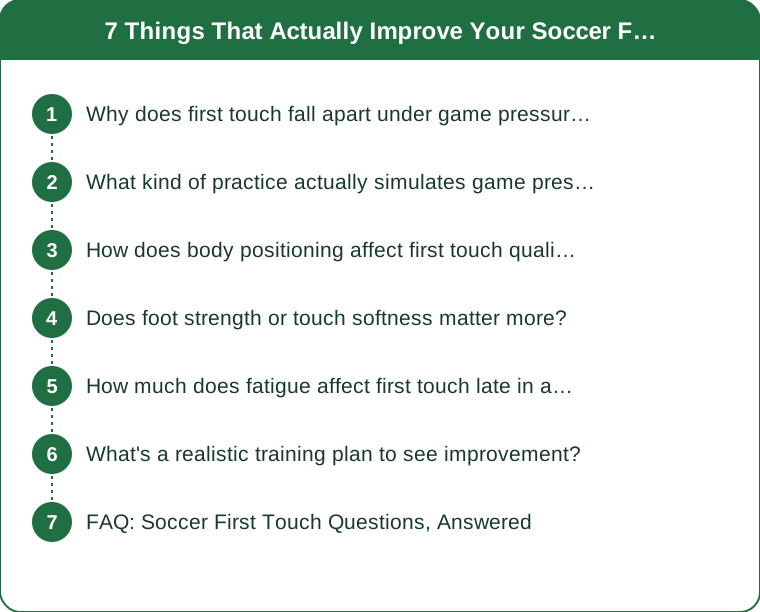
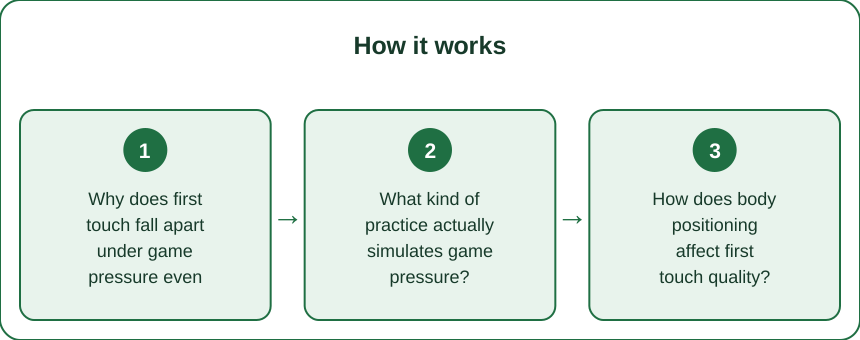
Why does first touch fall apart under game pressure even with good drill practice?
Static drills don’t train decision speed
Most first-touch drills are done standing still with no pressure, which trains the mechanical skill but not the split-second decision of where to direct the ball, which is what actually breaks down when a defender is closing in.
Peripheral awareness gets ignored in isolated practice
In games, your first touch has to account for where defenders and open space are simultaneously, not just where the ball is landing — something solo drills rarely simulate.
What kind of practice actually simulates game pressure?
Add a passive defender to touch drills
Even a training partner jogging toward you (not fully defending, just closing distance) forces you to redirect your first touch with real urgency, which is a much closer approximation of match conditions than an empty-field repetition.
Practice receiving while scanning
Check over your shoulder for space or an imaginary defender before the ball arrives — this single habit, borrowed from professional training methodology, dramatically improves in-game first touch because it trains the scan-then-touch sequence together instead of separately.
How does body positioning affect first touch quality?
Opening your hips before the ball arrives
Turning your body slightly sideways as the ball approaches (rather than receiving square-on) lets you direct your first touch forward into space immediately, cutting out a wasted extra touch that defenders can close down.
Using the correct surface for the situation
Using the inside of the foot for control and the outside for quick direction changes, rather than defaulting to one surface for everything, gives more options under pressure and reduces predictable touches defenders can anticipate.
Does foot strength or touch softness matter more?
Touch softness — the ability to cushion the ball’s pace rather than just stopping it dead — matters more than raw foot strength for first touch quality. Practicing ‘receiving away from pressure,’ where your first touch moves the ball a few feet in the direction you want to go rather than trapping it dead at your feet, builds this skill directly and translates immediately to game speed.
How much does fatigue affect first touch late in a game?
Significantly — first touch quality reliably drops in the last 15-20 minutes of a match as leg fatigue reduces fine motor control, which is why conditioning work isn’t separate from skill work; a tired body executes the same technique worse. Building general fitness alongside technical practice directly protects your first touch quality late in games.
What’s a realistic training plan to see improvement?
Three sessions a week combining wall-passing for repetition, pressure-simulated touch drills with a partner, and small-sided games (3v3 or 4v4) that force realistic decision-making under pressure will produce noticeably better game touch within 4-6 weeks. Isolated cone drills alone, without any pressure element, tend to plateau much faster.
FAQ: Soccer First Touch Questions, Answered
Can adult beginners meaningfully improve first touch, or is it mostly set young?
Adults can absolutely improve significantly with consistent, pressure-simulated practice — first touch is a trainable skill at any age, not a fixed trait from childhood.
How long until first touch under pressure actually improves?
Most players notice a meaningful difference within 4-6 weeks of consistent, pressure-based practice, versus months of plateau with static drills alone.
Does playing small-sided games help more than full 11v11 matches?
Yes, generally — smaller games mean more touches per player and more repetitions of pressure situations in the same amount of time.
TL;DR:
- Static drills train mechanics but not decision speed under pressure
- Add a passive defender or scanning habit to touch practice
- Open your hips and vary foot surface before the ball arrives
- Fatigue quietly ruins first touch late in games — conditioning matters too
- Small-sided games build pressure-tested touch faster than solo drills
First touch isn’t really about the ball — it’s about everything happening around it, which is exactly what pressure-based practice trains that solo drills never will.
Keep Reading
This article is for general informational and styling purposes only. Fit, sizing, and product availability may vary.