7 Things That Actually Improve Your First Touch Fast, According to How Coaches Actually Teach It
Quick Answer: First touch improves fastest through wall-passing at varied speeds, receiving with your body already turned toward your next move, and deliberately using both feet — not through juggling, which builds a different skill entirely.
A clean first touch is the single biggest visible gap between a comfortable player and someone still chasing the ball every possession. The good news is that it’s one of the most trainable skills in soccer, and it doesn’t require a full team or a fancy facility to build fast.

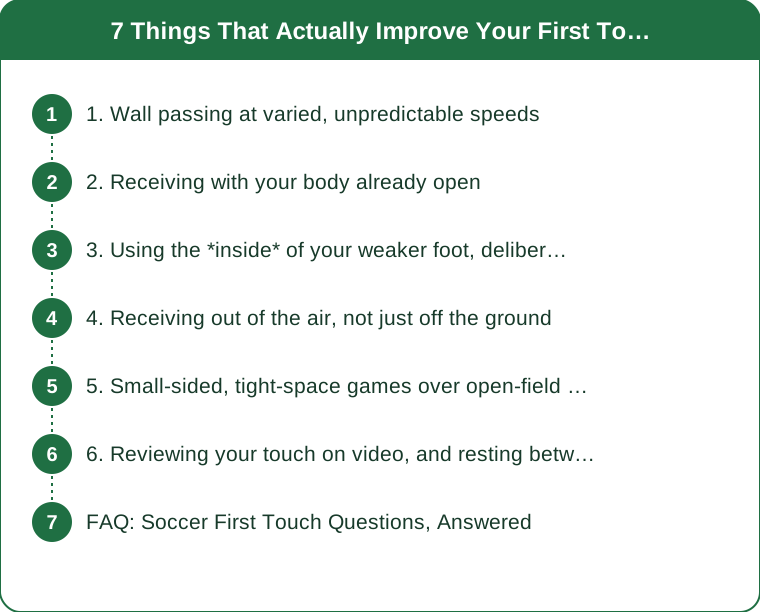
1. Wall passing at varied, unpredictable speeds
A wall (or rebound net) returns the ball at whatever pace and angle you send it, which is far closer to game conditions than a cooperative partner feeding you the same pass repeatedly. Mix your own pass speed and angle every few reps — a hard low pass, then a soft bouncing one — so your first touch has to adapt each time instead of grooving one repeated motion that won’t transfer to a real match.
20 minutes of varied-speed wall work most days builds first-touch adaptability faster than almost any other single drill, largely because it forces genuine decision-making under time pressure rather than rote repetition.
2. Receiving with your body already open
The single biggest first-touch mistake at every level below advanced is receiving square to the ball, which forces a second touch just to turn toward where you actually want to go. Before the ball arrives, check over your shoulder and angle your body — hips and chest already pointed toward your next target — so your first touch can push the ball directly into space instead of just stopping it.
Practice this specifically: have a partner pass while calling out a direction just before the ball arrives, forcing you to receive already-turned rather than receiving first and turning second.
3. Using the inside of your weaker foot, deliberately, every session
Most players default entirely to their strong foot in practice, which means their weak-foot first touch never develops past a beginner level even after years of playing. Dedicating even one-third of every touch session specifically to the weak foot closes this gap faster than most players expect — usually within a few consistent weeks, not months.

4. Receiving out of the air, not just off the ground
Ground-ball first touch and aerial first touch are genuinely different skills — cushioning a dropping ball with the instep or thigh to kill its momentum takes separate practice from redirecting a rolling pass. Simple toss-and-cushion reps against a wall or with a partner, focusing on the ball dying dead at your feet rather than bouncing away, build this specific skill directly.
5. Small-sided, tight-space games over open-field drills
First touch under real pressure is a different skill than first touch in an empty, cooperative drill. Playing 3v3 or 4v4 in a small grid forces quick, tight-space decisions that closely mirror actual match pressure — this is why players who focus heavily on small-sided games often develop faster, more match-ready first touch than those who only do isolated cone drills.
6. Reviewing your touch on video, and resting between focused sessions
Most players have no idea what their first touch actually looks like under pressure until they see it — a phone propped up during a scrimmage or small-sided game reveals patterns (always taking a heavy touch to the same side, always squaring up instead of opening) that are nearly invisible from the inside.
Skill acquisition research consistently shows that spaced, focused practice beats marathon sessions for building lasting technique — 20-30 minutes of genuinely focused first-touch work, 4-5 days a week, builds the skill faster than one exhausting 2-hour session where quality drops after the first 30 minutes.
Myth vs Fact
Myth: Juggling is the best way to improve first touch. Fact: Juggling builds ball feel and confidence, but the ball is airborne and self-directed — first touch specifically means controlling a ball someone else sent, which juggling doesn’t train directly. Myth: You need a partner to improve first touch fast. Fact: A wall or rebound net alone, used with varied pace and angle, builds first touch as fast or faster than most partner drills, and it’s available any time.
FAQ: Soccer First Touch Questions, Answered
How long does it take to noticeably improve first touch?
With consistent, focused practice (20-30 minutes, 4-5 days a week), many players notice a real difference within 3-4 weeks, with more advanced control developing over a few months.
Is juggling a waste of time for first touch?
Not a waste, but not the main lever either — it builds useful ball feel and confidence but should be paired with receiving drills, not relied on alone.
What’s the single best first-touch drill for a beginner adult player?
Varied-speed wall passing, alternating feet, is the highest-value starting point — it’s low-equipment, self-paced, and closely mirrors the unpredictability of real match passes.
TL;DR:
- Varied-speed wall passing beats juggling for direct first-touch improvement
- Receive with your body already turned toward your next move, not square to the ball
- Dedicate real practice time to your weak foot specifically
- Aerial touch and small-sided games each train skills isolated drills miss
- Short, focused sessions 4-5 days a week beat occasional marathon practices
First touch is one of the most trainable soccer skills — consistent, varied, focused reps close the gap faster than most players expect.
Keep Reading
This article is for general informational and styling purposes only. Fit, sizing, and product availability may vary.